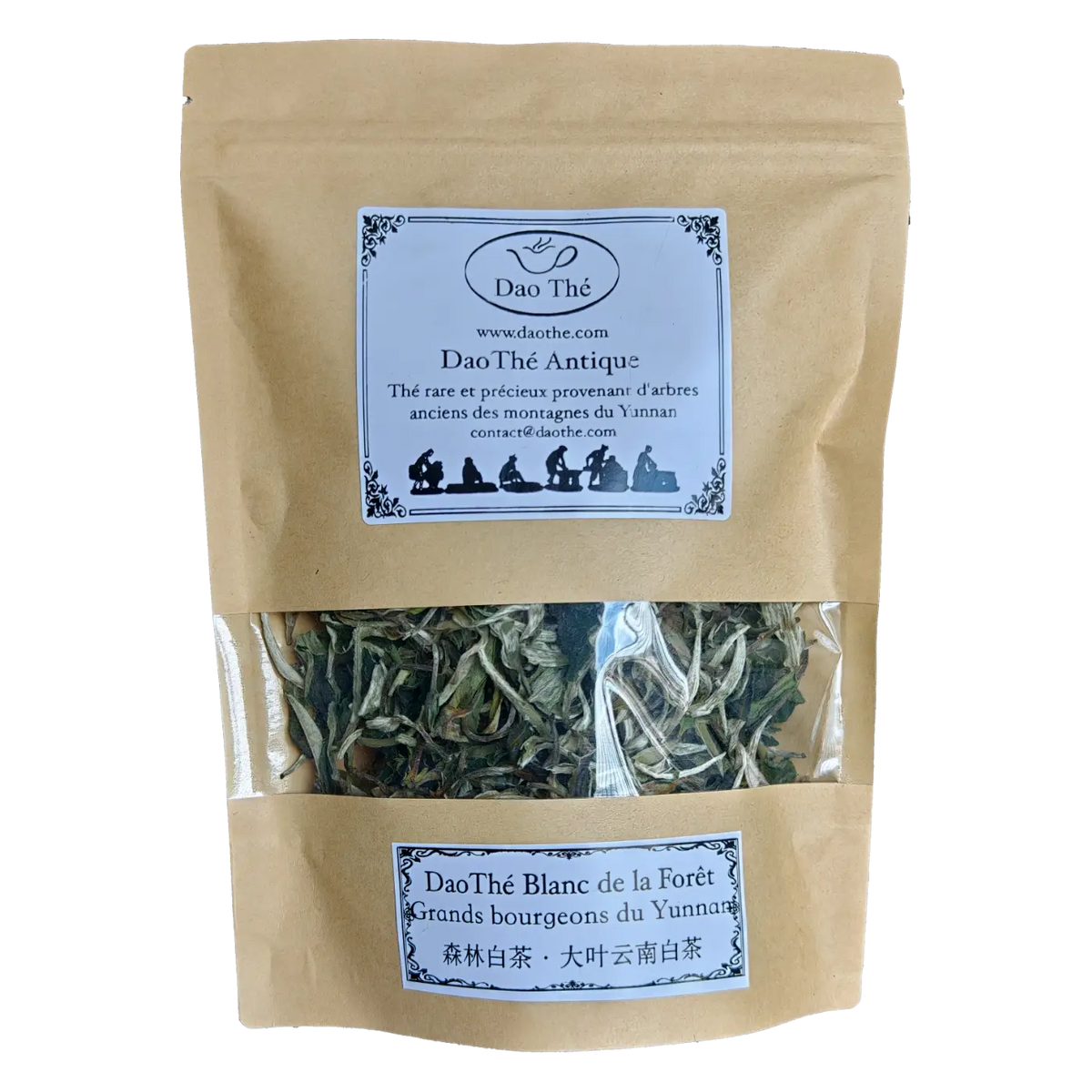
Daothé White from the Yunnan Forest
★★★★★1 reviews✦ Naturally low in caffeine, enjoyed from morning to night
€15 / 40 g, i.e. €38 / 100 g.
Handmade in Yunnan, from harvest to tea cake.
Forest buds, hand-picked at 1,800 m, naturally low in caffeine.
Our Yunnan white tea is tea in its purest form, barely processed, from forest tea trees that the mist almost never leaves. A golden liquor, sweet as honey, drunk hot or iced, from morning to evening.
A clear, lightly golden, luminous liquor. A floral nose, white flowers, mountain honey, a hint of peach or apricot. A silky, enveloping mouth, without the slightest astringency. A long, lightly sweet finish.
Why this tea
A tea for every hour. White tea naturally contains less caffeine than green or black teas: its very light processing preserves the leaf without concentrating its alkaloids. You can drink it in the morning to begin gently, in the afternoon for a pause, in the evening without fear of disturbing sleep. It suits adults and children alike, seasoned tea drinkers and newcomers alike.
Naturally concentrated in polyphenols. White tea, lightly oxidised, keeps the polyphenols of the fresh leaf, in particular catechins, whose transformation is minimal compared with green or black teas. It is a natural property of Camellia sinensis, tied to its light processing.
The tea of light slowness. There is no gravity in white tea. It is an airy, spring-like tea, which invites gentleness rather than depth, the window open onto the garden rather than solitary meditation. Each will find their own in it.
A traditional beverage, to be enjoyed as part of a varied diet and a balanced lifestyle.
Origin and terroir, Yunnan forest
This white tea is born in the forests of Yunnan, where the tea trees grow freely among the trees, in the intermittent shade of the canopy, on land that the morning mist almost never leaves. We are at over 1,800 metres of altitude, in south-western China, where the swings of temperature between day and night concentrate in each leaf an aromatic profile the plains cannot reproduce.
The tea trees of Yunnan belong to the large-leaf variety, Camellia sinensis var. assamica, which gives Yunnan white tea a rounder body and a more assertive presence on the palate than the white teas of Fujian. The buds are picked by hand, one by one, in spring, covered in a fine silvery-white down.
White tea is the least processed tea there is. After picking, the leaves are simply withered, spread in the open air, in gentle sun and in shade, for several days, then dried with care. No rolling, no abrupt heating, no intended oxidation. What you find in the cup is exactly what the forest put into the buds.
Preparation
White tea does not like water that is too hot: boiling water crushes its delicate aromas. Let it cool for a minute after the boil, or heat it straight to 80–85 °C. A low-mineral water is better than hard water. The leaves re-infuse two to four times and often reveal themselves better on the second infusion than the first.
With a gaiwan, to reveal every nuance. Four to five grams in a 100 to 150 ml gaiwan, water at 80–85 °C. First infusion twenty to thirty seconds, lengthening gradually with each round. Yunnan white tea withstands four to ten infusions and reveals a slightly different register each round — floral at first, more honeyed and full-bodied afterwards.
With a tea ball, the everyday gesture. Fill half a ball, place it in your cup or teapot, water at 80–85 °C, two to three minutes. The damp ball can give a second infusion by lengthening the time slightly. The ideal method for a fine cup without ceremony.
As a cold brew, perhaps the loveliest way. Four grams in 1.5 litres of cold water, in the fridge, four to eight hours, ideally a whole night. Cold infusion draws out the sweet, fruity aromas without touching bitterness. Strain, serve over ice. Keeps two to three days, chilled, in a closed carafe.
In a thermos, a discreet companion. Four grams in your thermos, water at 80–85 °C, no hotter, at the risk of bitterness. White tea, steeped at length, stays gentle and drinkable thanks to its low astringency. Light, fragrant, without any marked stimulating effect: ideal for the working day or for travel.
Storage
White tea is more sensitive to odours than fermented teas: its delicate aromas can quickly be absorbed by what surrounds it. Keep it in its resealed pouch, away from light, humidity and any source of odour: coffee, spices, household products. An opaque tin or ceramic box is ideal. Drink it within the year after opening to enjoy all its freshness.
Detailed tasting notes
The liquor is clear, lightly golden, luminous in the glass. The nose is floral, white flowers, mountain honey, a hint of peach or ripe apricot depending on the season. On the palate, it is sweetness that asserts itself first: silky, enveloping, without the slightest astringency. Then come more vegetal, fresh notes, recalling young grass or fern in spring. The finish is long and lightly sweet.
Hot, white tea is gentle and warming. Cold-brewed, it takes on another dimension: fresher, fruitier, with a crystalline clarity in which the floral aromas unfold freely. Perhaps that is how it is at its most beautiful.
Characteristics
- Type: White tea (Bai Cha)
- Origin: Yunnan, China, over 1,800 m altitude
- Format: whole buds and leaves, loose leaf
- Net weight: 40 g
- Ideal: hot or as a cold brew

Tea pressed by hand, as it was a thousand years ago
Qiao has been making tea for thirty years. By hand, following the old ways, she presses each cake herself on a stone mill, a craft handed down for more than a thousand years and today listed as intangible cultural heritage.
Our tea trees, some several centuries old, grow above 1,800 metres: we call them the "old immortals." Their leaves are fixed by hand in great woks heated over a wood fire, then rolled. Six months a year, we are there, at every step.