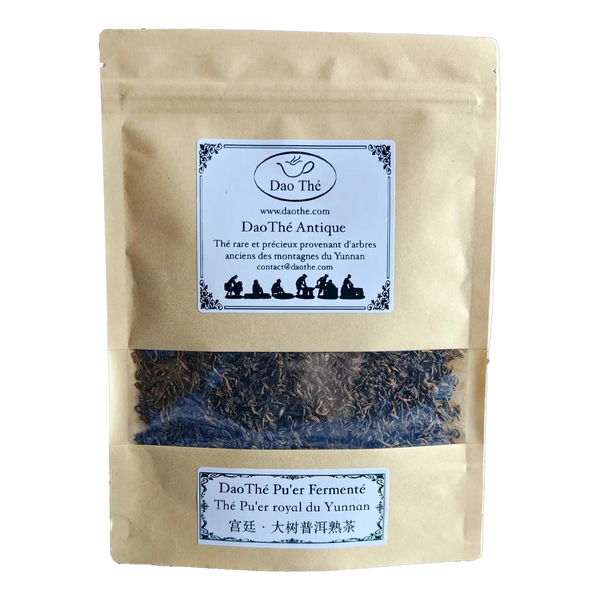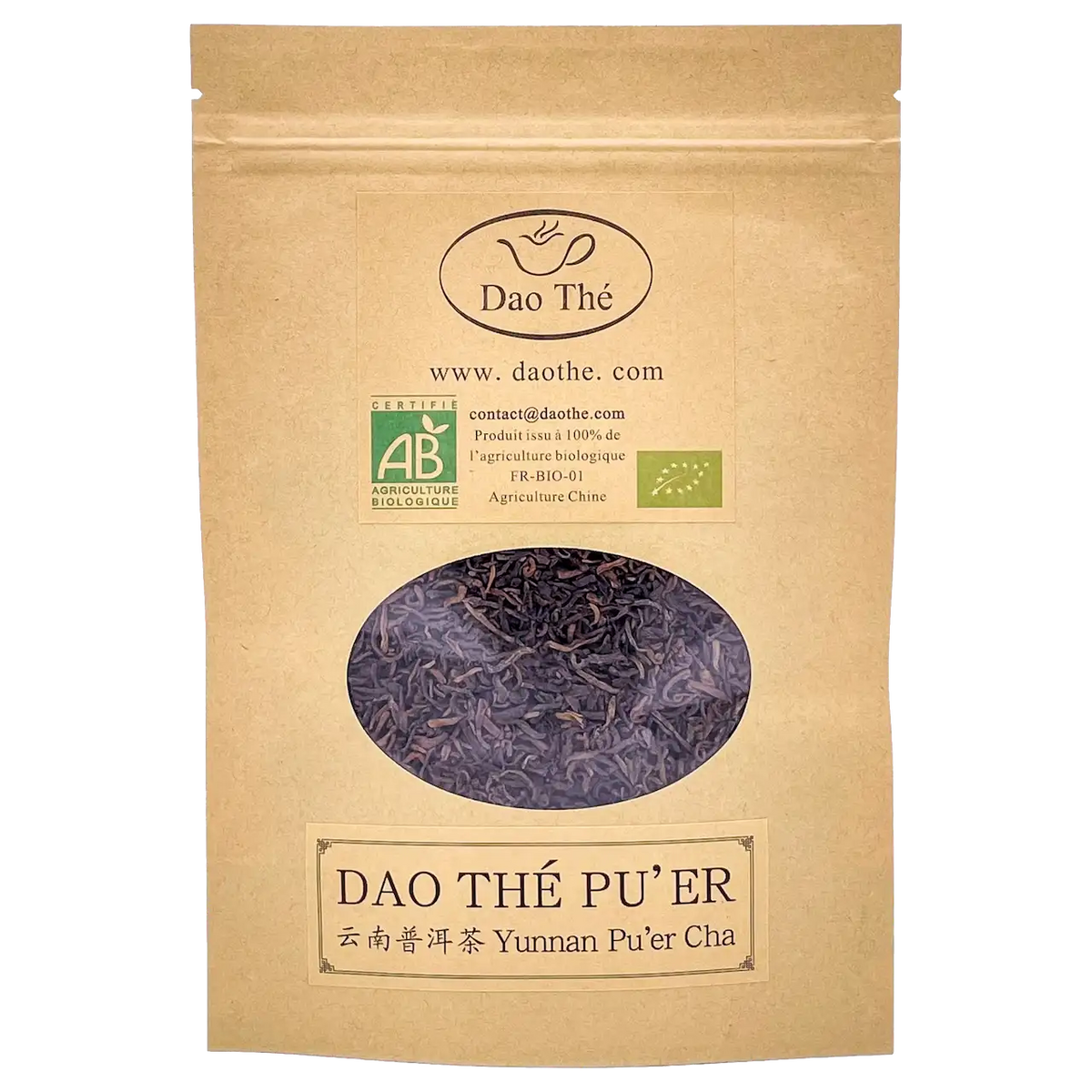
Daothé Organic Pu'er
★★★★★14 reviews✦ Naturally low in caffeine, enjoyed from morning to night
€27 / 50 g, i.e. €54 / 100 g.
Handmade in Yunnan, from harvest to tea cake.
Naturally caffeine-free. Organic Gong Ting buds, Yunnan.
A Chinese dark tea (also spelled Pu erh), slowly fermented and grown organically at over 1,800 metres of altitude — the kind you keep close all day long and share gladly with the people you love.
Handmade in our workshop in Yunnan.
A dark, round, velvety liquor, without the slightest astringency. Woody notes, lightly earthy, sometimes sweet like a hint of ripe fruit or precious wood.
Why this tea
Pu'er holds a singular place in Chinese culture — that of a companion to meals and to the close of the day. Along the ancient Tea Horse Road, caravans carried it from Yunnan to Tibet and Mongolia, and it was gladly drunk after meats and rich foods, much as one offers a herbal infusion at the end of a meal today.
An aid to digestion. Chinese tradition has recognised the digestive virtues of fermented Pu'er for centuries. It is, above all, the tea you offer after a hearty meal: its gentle character, its roundness on the palate and its warmth have made it inseparable from the great tables of southern China, where it accompanies the end of the meal like a gesture of ease.
Naturally very low in caffeine, naturally rich in polyphenols. Its long fermentation makes Pu'er particularly low in caffeine; it suits adults and younger drinkers alike, and does not disturb sleep. Like every tea from Camellia sinensis, it naturally contains polyphenols, whose profile fermentation transforms over months and years — and this is what gives it its unique signature among teas.
The tea of slowness. Beyond its own virtues, Pu'er invites a gesture: to slow down, to take your time, to drink slowly. Perhaps that is its first gift — the one you find again in every cup.
Pu'er is a traditional beverage, to be enjoyed as part of a varied diet and a balanced lifestyle. It is not a substitute for medical advice.
Origin and terroir
Our organic Pu'er comes from the unspoilt mountains of Yunnan, in south-western China, where the tea tree has grown wild for centuries. It is made solely of young buds — the very ones once called Gong Ting, the “Imperial Court tea”, because they were reserved for the Emperor alone. Grown under certified organic farming, it honours a living tradition built on patience and respect for the land.
Preparation
Choose a pure, low-mineral water brought to a full boil: fermented Pu'er loves heat and does not fear high temperatures. A teaspoon (about three grams) is enough for a litre; half a tea ball will steep two to three. The buds withstand several successive infusions — as long as they give colour, they still give flavour. Let the shade of your cup guide you rather than the timer.
With a gaiwan, the traditional Chinese way. Place 5 to 7 grams of leaves in a 100–150 ml gaiwan, pour in boiling water, then follow with short infusions — ten seconds for the first, lengthening the time a little with each round. Pu'er will give six to ten infusions this way, sometimes more, gradually revealing its depth. This is the method known as gongfu cha, the slow gesture of tea.
With a tea ball, the everyday gesture. Half a tea ball is enough for two to three litres: place it in your vessel, pour boiling water over it, let it steep three to five minutes to your taste, then lift it out. Set the damp ball aside — it can give a second, even a third infusion later in the day, simply by steeping a little longer.
In a teapot, cast iron or ceramic. The teapot suits Pu'er especially well, for it loves sustained heat. Allow three grams of leaves per litre of fully boiling water, and steep three to five minutes for the first cup. Re-infuse the leaves, lengthening the time with each round. If you enjoy the ritual, devote your teapot to this tea: over the years it will season and lend each infusion a little more depth, as the tradition of Yixing clay teapots would have it.
In a thermos, the practical and thrifty way. Place three to five grams of leaves straight into your thermos, pour in fully boiling water, and close it. You can drink throughout the day: the leaves keep steeping gently, and the tea holds its roundness without turning astringent — the mark of a good Pu'er. A single measure is enough from morning to evening.
Storage
Like fine wines, fermented Pu'er crosses the years losing nothing; on the contrary, it gains in depth and complexity. Simply keep it away from light and strong odours, in its resealed pouch or a clean tin. You may forget it for a few months, even a few years, at the back of a cupboard: it will wait for you, and it will thank you.
Tasting notes
The liquor is dark, round, velvety, without the slightest astringency. The palate finds woody notes, lightly earthy, sometimes sweet like a hint of ripe fruit or precious wood. Very low in caffeine, this Pu'er can be drunk from morning to evening without disturbing sleep: a tea for adults and younger drinkers alike, and especially fine at the end of a meal.
Characteristics
| Type | Fermented Pu'er (Shou Pu'er) |
| Origin | Yunnan, China, over 1,800 m altitude |
| Certification | Organic farming (AB-certified) |
| Format | Whole buds, loose leaf |
| Net weight | 50 g |
To go further
Three reads to know this tea better and prepare it as we do.
- What is Pu'er tea? — origins, terroirs, traditional virtues.
- Fermented Pu'er or raw Pu'er — two families, two characters, how to choose.
- How to prepare Pu'er tea — gaiwan, teapot, tea ball, thermos.

Tea pressed by hand, as it was a thousand years ago
Qiao has been making tea for thirty years. By hand, following the old ways, she presses each cake herself on a stone mill, a craft handed down for more than a thousand years and today listed as intangible cultural heritage.
Our tea trees, some several centuries old, grow above 1,800 metres: we call them the "old immortals." Their leaves are fixed by hand in great woks heated over a wood fire, then rolled. Six months a year, we are there, at every step.