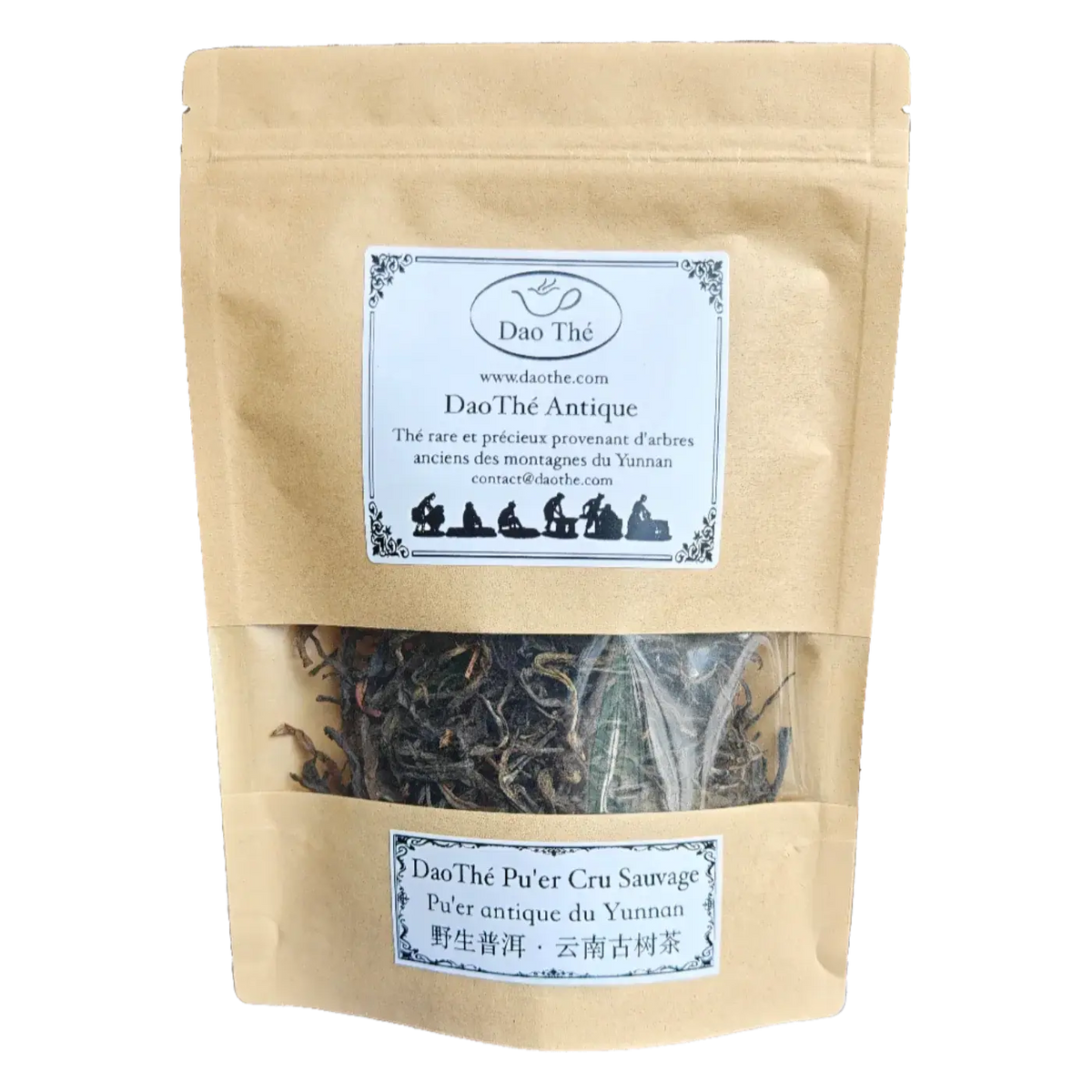
Wild Antique Raw Pu'er from Yunnan
★★★★★3 reviews✦ Naturally low in caffeine, enjoyed from morning to night
€15 / 50 g, i.e. €30 / 100 g.
Handmade in Yunnan, from harvest to tea cake.
Naturally low in caffeine. Century-old wild tea trees from the heights of Yunnan.
A Sheng Pu'er, a raw tea, from century-old wild tea trees that have grown freely for centuries on the heights of Yunnan, and have crossed time untouched by human hands. Hand-harvested and hand-shaped in our workshop in Yunnan.
A golden, clear, luminous liquor. A floral, lightly camphored nose, the scent of a forest after rain. A fresh, herbaceous mouth, without bitterness. The huigan, the sweet return, is long. Notes of dried flowers, wild honey, a hint of green wood.
Why this tea
A tea for contemplation. Sheng Pu'er is not drunk in a hurry. It asks for a little attention: to the water temperature, the steeping time, the way it changes from cup to cup. This is precisely what makes it a meditative tea: it brings you back to the present, to the moment of the cup. Perhaps that is its first gift.
Naturally rich in polyphenols. Less processed than fermented Pu'er (Shou), Sheng keeps an aromatic and nutritional profile closer to green tea — active, lively, invigorating. Like every tea from Camellia sinensis, it naturally contains polyphenols whose profile evolves with ageing.
Caffeine content: low. Our raw Pu'er contains little caffeine. It can be enjoyed throughout the day. Avoid late cups if you are very sensitive to caffeine.
Pu'er is a traditional beverage, to be enjoyed as part of a varied diet and a balanced lifestyle. It is not a substitute for medical advice.
Origin and terroir
The tea trees that give this tea are not planted in rows: they grow wild, deep in the forest, on the wooded slopes of Yunnan between 1,800 and 2,500 metres of altitude. No pesticides, no artificial irrigation: their roots reach down alone into the red, clay-rich earth to find their water and their nutrients.
In China, these trees have a particular name: the gushu (古树), the “old trees”. The older a tea tree, the fewer its leaves, and the more they concentrate a mineral and aromatic complexity that young plantations simply cannot reproduce. The pickers harvest them by hand, one bud at a time, in spring and in autumn. Their energy is entirely different.
Sheng Pu'er is a deliberately little-processed tea. After picking, the leaves are lightly withered in the sun, passed briefly through large heated woks to stop oxidation — this is the shaqing, the “kill-green”, the bruising by heat — then rolled by hand and dried in the sun. No accelerated fermentation, no industrial press. What happens next is the work of time alone: the leaves go on living, slowly transformed by the natural micro-organisms in the air of Yunnan, by the seasonal shifts of temperature and humidity.
For centuries, the leaves of Yunnan travelled the Tea Horse Road to reach Tibet, Mongolia, Sichuan. The caravans carried them pressed into cakes, strapped to the backs of mules, across snowy passes at four thousand metres. It was on the road that the tea fermented, transformed by altitude, humidity and months of travel. This is no legend: it is the very origin of Pu'er as we know it.
There is something of that spirit in this tea — a certain resistance to time, a depth that reveals itself only to those who know how to stop. One does not drink a Sheng Pu'er distractedly. One settles into it.
Preparation
Choose a pure, low-mineral water. For Sheng Pu'er, water at 90–95 °C reveals the floral aromas and releases its sweetness. The leaves withstand many successive infusions: as long as they give colour, they still give flavour.
With a gaiwan, the royal way of Sheng. The gaiwan is the ideal vessel: its fine porcelain holds none of the aromas, and its small size allows short infusions that reveal the tea's progression from cup to cup. Place 5 to 7 grams of leaves in a 100 to 150 ml gaiwan, pour water at 90–95 °C. Follow with short infusions, ten seconds for the first, lengthening gradually. Sheng easily withstands more than 10 infusions, sometimes more, gradually unveiling its aromatic layers. This is the method of gongfu cha, the patient gesture of tea.
With a tea ball, the everyday gesture. Half a tea ball is enough for two to three litres: place it in your vessel, pour water at 90–95 °C over it, let it steep two to four minutes to your taste, then remove it. The damp ball can give a second, even a third infusion by steeping a little longer: Sheng is generous on this point.
In a teapot, preferably Yixing clay. The Yixing clay teapot is the traditional companion of raw Pu'er: its natural porosity slowly absorbs the tea's aromas and enriches each following infusion. If you do not have one, a ceramic or cast-iron teapot does very well. Allow five grams per litre of water at 90–95 °C, and steep two to four minutes for the first cup. Re-infuse the leaves, lengthening the time gradually. If you can, devote this teapot to your Sheng: over the months, it acquires memory.
In a thermos, the practical way for the day. Place three grams of leaves straight into your thermos, pour water at 90–95 °C, and close it. You can drink throughout the day: the leaves keep steeping gently. Top up with water as the day goes on. It is the method of the travellers of the Tea Horse Road, revisited.
Storage
Sheng Pu'er is one of the few teas in the world that truly improves with the years. Connoisseurs buy it in quantity to lay it down, as one would a fine wine, and certain vintages reach considerable prices after twenty or thirty years of ageing.
Simply keep it away from light, strong odours and excessive humidity, in its resealed pouch or in a box of wood, ceramic or terracotta. Avoid airtight plastic, which blocks natural aeration. You may forget it for months, or years, at the back of a cupboard: it will wait for you, and it will have changed.
Tasting notes
The liquor is golden, clear, luminous. The nose is floral and lightly camphored, a scent of forest after rain. On the palate, a herbaceous freshness first, no bitterness, a fine and clean sweetness that carries the aromas and leaves a soft salivation for a long while: this is what the Chinese call the huigan, the “sweet return”, the signature of great raw Pu'er. Notes of dried flowers, wild honey, a hint of green wood.
With the years (and Sheng Pu'er keeps for decades), the liquor darkens, the sweetness evolves, and notes of dried fruit, old wood and soft leather appear. It is a living tea, in the truest sense of the word.
Characteristics
| Type | Raw Pu'er (Sheng Pu'er) |
| Origin | Yunnan, China, century-old wild tea trees (gushu), 1,800–2,500 m |
| Format | Whole leaves, loose leaf |
| Net weight | 50 g |
To go further
Three reads to know this tea better and prepare it as we do.
- What is Pu'er tea? — origins, terroirs, traditional virtues.
- Fermented Pu'er or raw Pu'er — two families, two characters, how to choose.
- How to prepare Pu'er tea — gaiwan, teapot, tea ball, thermos.
Detailed characteristics
| Terroir | Ancient wild tea trees of Yunnan, the DaXueShan mountains and the Mengku region |
| Altitude | 2,000 to 2,200 metres |
| Type | Sheng (raw) |
| Grade | Antique wild (tea trees over a century old) |
| Harvest | Spring harvest |
| Aromatic profile | Floral, fresh, honeyed |
| Ageing potential | Several decades, improves with time |
| Sourcing | Direct from the grower, ancient tea trees, hand-harvested |
Who it's for
For enthusiasts who want to taste a sheng from ancient trees.
Best drunk gong fu cha style, with short, repeated infusions.
Chinese tradition attributes to lively, floral sheng an invigorating energy suited to the waking moments of the day.
To go further
Discover Gushu: what is an ancient-tree tea and Pu'er, caffeine and theine on our blog.

Tea pressed by hand, as it was a thousand years ago
Qiao has been making tea for thirty years. By hand, following the old ways, she presses each cake herself on a stone mill, a craft handed down for more than a thousand years and today listed as intangible cultural heritage.
Our tea trees, some several centuries old, grow above 1,800 metres: we call them the "old immortals." Their leaves are fixed by hand in great woks heated over a wood fire, then rolled. Six months a year, we are there, at every step.