Pu'er (or pu'erh) is a generous tea: it forgives almost anything and always gives something. But when prepared with a little attention, it gives much more. Here is our reference guide—complete, precise, method by method—to make your tea perfectly every time, from the simplest gesture to the finest Gong Fu Cha.
THE ESSENTIAL IN 30 SECONDS
Dose: For Gong Fu Cha, 1g of leaves per 15 to 20ml of water (i.e., 5 to 8g for a 100-120ml gaiwan). For a teapot or mug, 3 to 4g per 250ml.
Water: Low mineral content, 90-95°C for young raw Pu'er, full boil (95-100°C) for fermented Pu'er or aged raw Pu'er.
Rinsing: A short rinse (5-10s) that is discarded, to awaken the leaves.
Infusions: 1st steeping 10-20s, then +5-10s for each subsequent steeping. A good Pu'er can last 10 to 15 infusions, sometimes more.
The golden rule: lots of leaves, little water, short and repeated infusions.
The three principles that really matter
Before utensils and timers, three principles account for 90% of the result. If you only remember these, your tea will already be very good.
Good water. Tea is more than 98% water. Low-mineral spring water makes more of a difference to your cup than any accessory. We've dedicated an entire article to water and Pu'er.
Generous dosing. Pu'er is prepared with a lot of leaves in a little water, contrary to Western custom. This allows for short, multiple infusions, and it's where the tea reveals its full depth.
The patience to re-infuse. Pu'er is not meant to be drunk all at once. It unfolds pass after pass: the first is light, the middle ones deliver the body, the last ones reveal the depth. To re-infuse is to listen to the tea change.
What do you need?
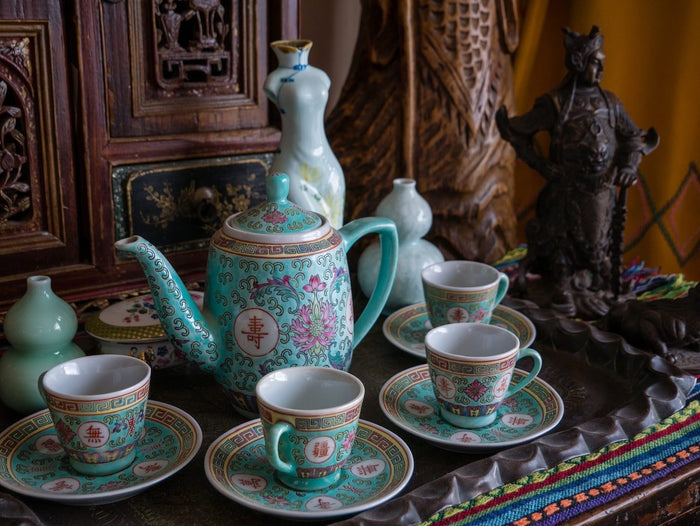
You can start with almost nothing—a mug and hot water—or equip yourself with a proper tea tray. Here are the utensils, from most essential to most refined.
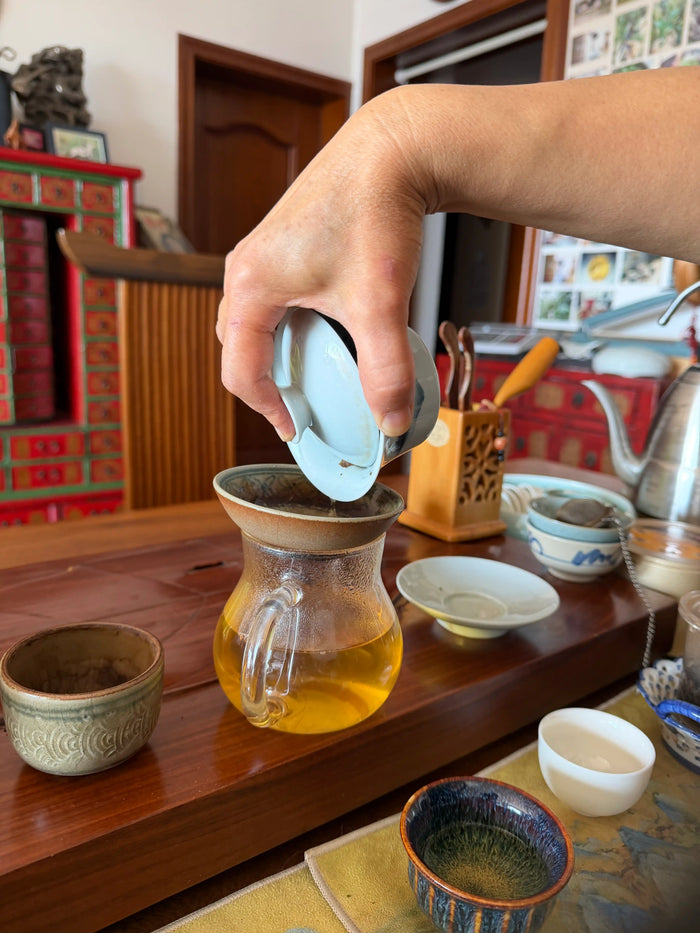
The gaiwan. A lidded bowl, made of porcelain, 100 to 150 ml. It's the most versatile tool and the best starting point: neutral, it retains nothing and delivers the tea as it is. If you were to buy only one thing, this would be it.
The Yixing teapot. A small unglazed zisha clay teapot, porous, which "seasons" over time and rounds out the liquor. It should be dedicated to a single type of tea (one for raw, one for fermented). A long-term companion, after the gaiwan.
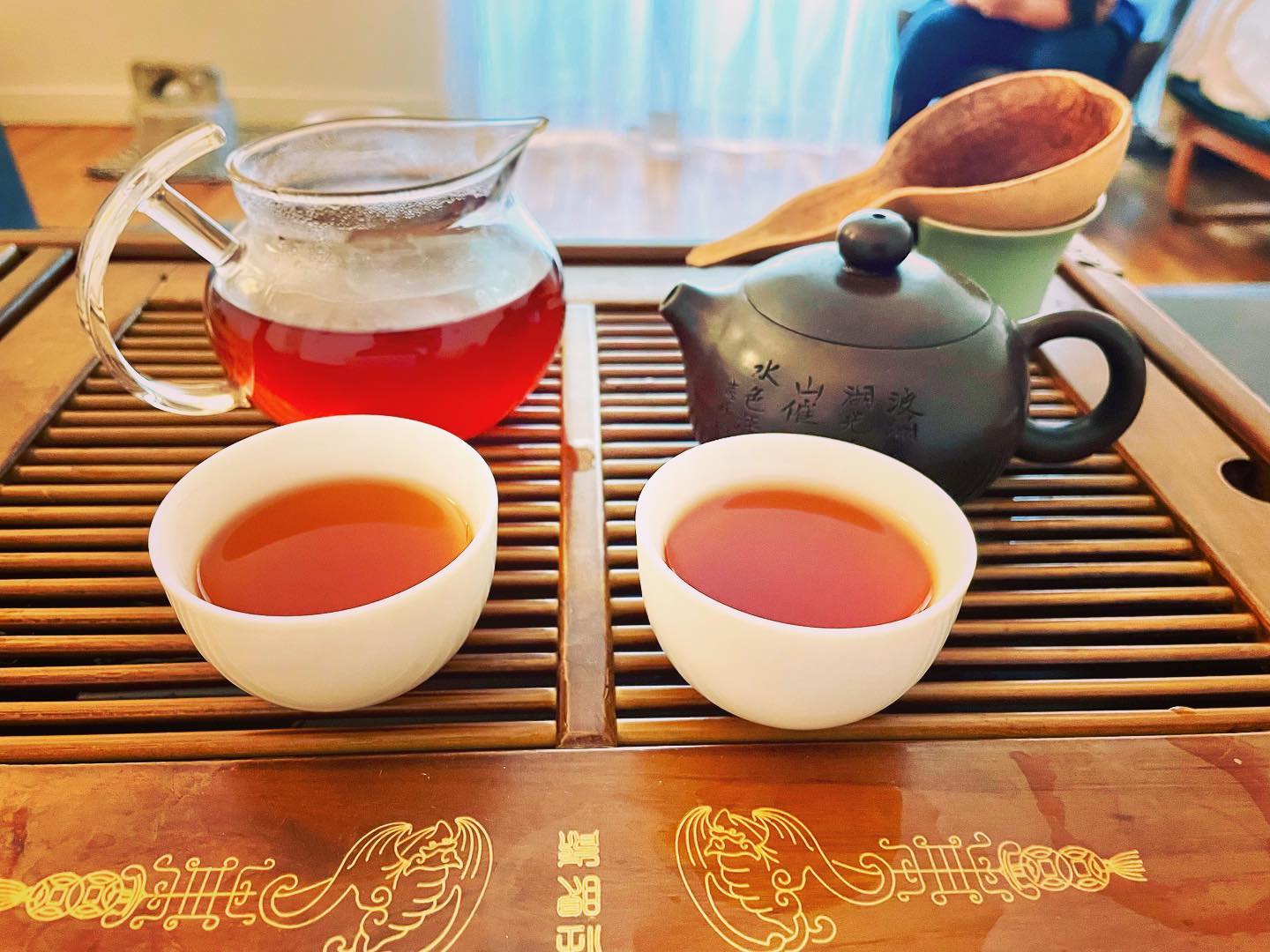
The cha hai (fairness pitcher). A small pitcher into which the gaiwan is completely emptied after each infusion. It homogenizes the liquor and allows serving multiple cups of identical taste.
The cups. Small (30 to 50 ml), made of fine porcelain. You drink little with each pass, but often.
A scale and a temperature-controlled kettle. Two discreet but valuable allies: the scale (to the nearest gram) for precise dosing, the adjustable kettle for adjusting the temperature according to the tea. Initially, a simple measuring cup and thermometer will suffice.
The tea pick (cha zhen). Essential for cleanly detaching leaves from a cake or tuo without breaking them. We'll come back to this below.
Where to get utensils? A porcelain gaiwan can be found for a few euros in any good tea house, both in-store and online. Start minimal—a gaiwan, a fairness pitcher, two cups—you can complete it later, once you know which Pu'er you enjoy daily.
Water and temperature, by Pu'er type
Low-mineral spring water (dry residue less than 120 mg/L) yields the best results; hard tap water flattens the aromas. As for temperature, Pu'er likes heat, but a young raw Pu'er should be handled a little more gently to avoid awakening its bitterness.
| Pu'er Type | Temperature | Why |
|---|---|---|
| Young Raw (Sheng) Pu'er | 90–95 °C | To preserve delicate floral notes without exacerbating bitterness. |
| Aged Raw (Sheng) Pu'er | 95–100 °C | Tannins have softened; heat reveals the depth. |
| Fermented (Shou) Pu'er | 100 °C | Full boil, for roundness and woody notes. |
One last detail, often overlooked: only boil water once. Water re-boiled multiple times loses its dissolved oxygen and results in flat tea. Fill the kettle with fresh water for each session.
Dosing, method by method
The correct dosage depends on the method. The standard rule for Gong Fu Cha is 1 gram of leaves per 15 to 20 ml of capacity. For longer infusions (mug, Western teapot), much less is used, as the tea remains in contact with the water for a longer time.
| Method | Dosage | Ratio |
|---|---|---|
| Gong Fu Cha (gaiwan) | 5 to 8 g / 100-120 ml | ~1 g per 15-20 ml |
| Western teapot / mug | 3 to 4 g / 250 ml | ~1 g per 70 ml |
| Thermos (grandpa style) | 3 to 5 g / 350-500 ml | continuous infusion |
| Cold brew | 5 g / 500 ml | 8-12 hrs in fridge |
Method 1 — Gong Fu Cha, the reference method
This is the method we practice every day in the mountains of Yunnan, and the one that best does justice to a Pu'er. The principle: many leaves, little water, very short infusions that are repeated. Each pass reveals a new facet. We dedicate an entire guide to Gong Fu Cha; here are the complete steps.
1. Heat the utensils. Pour boiling water into the gaiwan, cha hai, and cups, then empty. The ceramic will be at temperature, and the first infusion won't cool down upon contact with a cold bowl.
2. Dose. 5 to 7g for a 100-120ml gaiwan. Weigh at first: you'll get the hang of it with practice.
3. Rinse (awakening the leaves). Pour hot water, cover, wait 5 to 10 seconds, then discard this first water. This rinse (xǐ chá) doesn't clean: it awakens and opens the leaves. For a shou or a very compressed cake, two short rinses are sometimes useful.
4. First infusion. Pour the water (at the correct temperature depending on the type), cover, count 10 to 20 seconds, then empty completely into the cha hai. Do not leave anything in the gaiwan, otherwise the leaves will oversteep and the next pass will be unbalanced.
5. Subsequent infusions. Repeat, adding 5 to 10 seconds to each pass. Around the 8th or 9th pass, extend the time significantly (30s, 1 min, more). A good Pu'er can last 10 to 15 infusions, and a tea from ancient trees often more.
Actions that make a difference: pour in a circle to wet all the leaves; empty to the last drop; lift the lid between passes to smell the "gaiwan bottom," which indicates if the tea still has more to give.
Method 2 — In a teapot (Yixing, cast iron, or ceramic)
The teapot is well suited for Pu'er, which likes sustained heat. Two possible uses. In Gong Fu style, dose as with a gaiwan (1g per 15-20ml) and perform short infusions. In Western style, use 3 to 4g per 250ml, full boil, 3 to 4 minutes, and re-infuse two or three times, extending the steeping time.
If you appreciate the ritual, dedicate an Yixing clay teapot to a single type of Pu'er. Over the months, the porous clay absorbs the tea's oils and rounds out the liquor—a refinement that porcelain does not provide.
Method 3 — With a tea ball or in a mug
This is the everyday method, requiring no special equipment. A well-filled spoon (about 3g) in a tea ball or infuser, for a 250ml mug. Use very hot water, steep for 3 to 4 minutes, then remove the tea ball to avoid bitterness. Keep the damp leaves aside: they will yield a second, or even a third, cup throughout the day, by extending the steeping time slightly.
This is the simplest way to discover loose Pu'er: since the leaves are already detached, dosing is immediate.
Method 4 — In a thermos ("grandpa style")
The most underrated method, yet the most common in China: sometimes called "grandpa style" or "driver's tea." Place 3 to 5g of leaves directly into a thermos, pour boiling water, and close. The leaves infuse gently, and Pu'er—especially shou—maintains its roundness without becoming astringent. A single dose lasts all day; simply add hot water as needed.
Method 5 — Cold brew, for summer
A modern use that works very well with Pu'er, especially sheng. Put about 5g of leaves in a half-liter carafe of cold water, close, and leave in the refrigerator for 8 to 12 hours (overnight). The slow, cold extraction yields a soft, sweet, very low-bitterness liquor, and releases even less caffeine. Ideal in hot weather.
Adapt according to your Pu'er
Not all Pu'er teas are prepared in exactly the same way. Here are some useful adjustments, once the basic principles are understood. To better understand these categories, see our article on raw or fermented Pu'er.
Young Raw (Sheng) Pu'er. The most demanding. Water at 90-95°C, short and precise infusions, very brief rinse (or even skipped). Too hot or too long, it becomes bitter and astringent.
Aged Raw (Sheng) Pu'er. More forgiving. Almost boiling water, normal rinse, it unfolds a round depth over many infusions.
Fermented (Shou) Pu'er. The easiest. Full boil, one or two short rinses (it is very compressed and sometimes dusty on the surface), then generous infusions. Practically indestructible.
Cake, brick, tuo or loose. Loose leaf is dosed directly. Compressed forms need to be broken apart (see below) and open up more slowly: allow for one or two extra infusions for them to reach their full potential.
Breaking apart a cake or tuo, cleanly
The gesture makes the quality of the infusion. Hold the cake flat, insert the tea pick (cha zhen) parallel to the layers of leaves, on the edge, and gently pry to detach an entire fragment. The goal is to separate the leaves without breaking them: whole leaves infuse more clearly, broken leaves release their tannins too quickly and result in bitterness. Always take a little from the surface and a little from the depth, for a representative sample of the cake.
Common mistakes (and how to correct them)
The tea is too bitter / astringent. Too many leaves, water too hot, or infusion too long. Reduce the time, lower the temperature a little (especially for a young sheng), and empty the gaiwan thoroughly between steeps. If a cake has a lot of broken leaves, significantly shorten the first infusions.
The tea is bland, without body. Not enough leaves, water not hot enough, or water too demineralized. Increase the dosage, raise the temperature, and choose slightly mineralized water.
The liquor is cloudy or "flat". Hard water or re-boiled water. Switch to lightly mineralized spring water, boiled only once.
The tea is exhausted after 3-4 infusions. Either the raw material was ordinary, or you over-infused at the beginning (extracted everything at once). With good Pu'er and short steeps, aim for 10 infusions or more.
Read and adjust during tasting
Preparing Pu'er also means listening to it. Three benchmarks. The color of the liquor indicates the concentration: too pale, extend the time; too dark, shorten. The aroma from the bottom of the gaiwan (the wet leaves) tells what it still has to give: floral and long, the tea has reserves; faint and simple, we are approaching the last steeps. The huí gān finally — that sweet aftertaste that rises in the throat after a sip — is the signature of a beautiful tea: it's what we seek, more than power.
Summary table
| Method | Dosage | Temperature | Time | Infusions |
|---|---|---|---|---|
| Gong Fu Cha | 5-7 g / 100-120 ml | 90-100 °C | 10-20 s, +5-10 s/steep | 10 to 15+ |
| Teapot (Western) | 3-4 g / 250 ml | 95-100 °C | 3-4 min | 3 to 5 |
| Tea ball / mug | 3 g / 250 ml | 95-100 °C | 3-4 min | 2 to 3 |
| Thermos (grandpa style) | 3-5 g / 350-500 ml | 100 °C | continuously | all day |
| Cold brew | 5 g / 500 ml | cold water | 8-12 h in fridge | 1 (drink chilled) |
Frequently asked questions
How many grams of Pu'er for one cup?
It depends on the method. For Gong Fu Cha (the reference), count about 1 g per 15 to 20 ml of water, which is 5 to 7 g for a 100-120 ml gaiwan. For long infusions (mug or Western teapot), 3 to 4 g per 250 ml is sufficient, because the contact with water lasts longer.
What water temperature for Pu'er?
Full boil (95-100 °C) for a fermented (shou) Pu'er or an aged raw Pu'er. Slightly below (90-95 °C) for a young raw (sheng) Pu'er, to preserve its finesse without awakening bitterness. In all cases, use lightly mineralized spring water, boiled only once.
Should Pu'er tea be rinsed before drinking?
Yes, a short rinse (5 to 10 seconds, discard water) is recommended. It is not for "cleaning" but to awaken and open the leaves, especially for compressed tea. For a shou or a very dense cake, two short rinses are sometimes preferable; for a young sheng, a very brief rinse is sufficient.
How many times can Pu'er be re-infused?
In Gong Fu Cha, a good Pu'er easily holds 10 to 15 infusions, sometimes more than 20 for tea from ancient trees. For long infusions (mug, teapot), count 2 to 5 steeps. Each infusion reveals a different facet: the first are vibrant, the middle ones deliver the body, the last ones the base.
How to brew loose leaf Pu'er?
Exactly like a cake, but simpler since the leaves are already detached: directly weigh your dose (5 to 7 g for gaiwan, 3 to 4 g for mug), rinse briefly, then follow with short infusions that you gradually lengthen. It's the ideal form for beginners.
My Pu'er is too bitter: what should I do?
Three levers: fewer leaves, slightly less hot water (especially for a young sheng), and shorter infusions. Also make sure to empty the gaiwan completely between steeps — stagnant water will over-steep the leaves. If the cake is very broken, significantly shorten the first infusions.
Can Pu'er be drunk in the evening?
Yes, especially fermented Pu'er, which is naturally very low in theine. Its long fermentation degrades much of the theine, and many drink it in the evening without affecting sleep. We detail this point in our article Pu'er, caffeine and theine.
What is the minimum equipment to get started?
A porcelain gaiwan (or, failing that, a tea ball and a mug), lightly mineralized spring water, and something to heat the water. That's all. A scale, a fair cup (cha hai), and a Yixing teapot come later, as enjoyment grows.
To go further
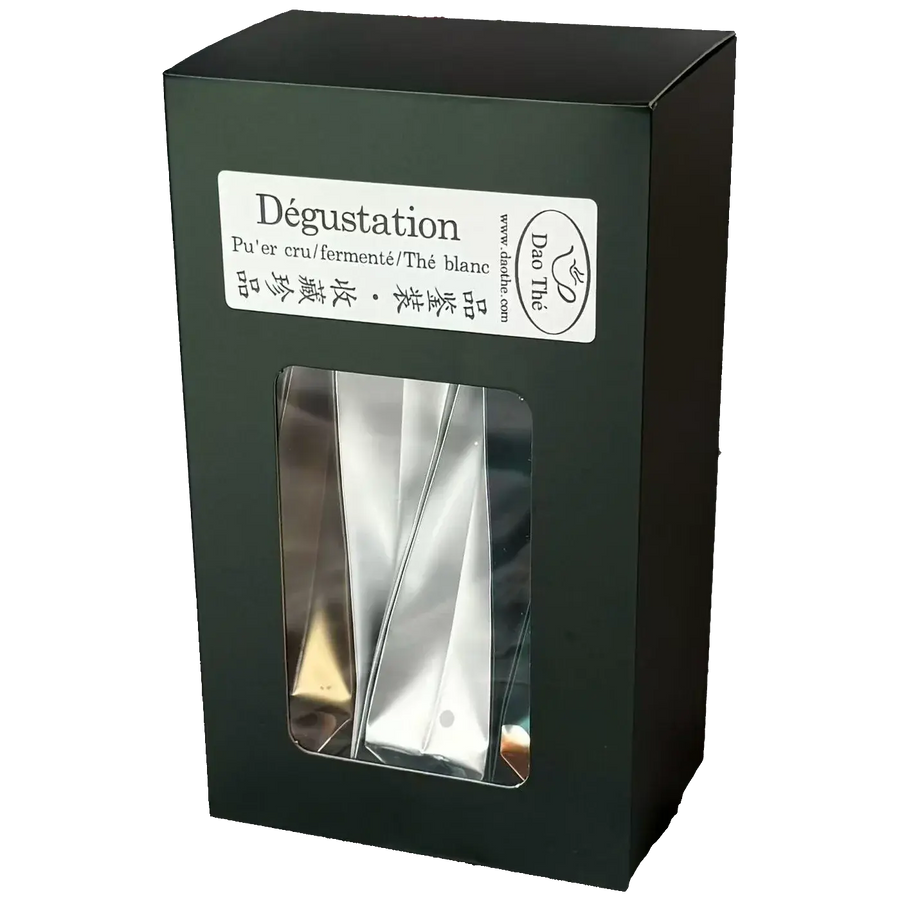
No Pu'er on hand yet? Start with our Organic Gong Ting Pu'er buds — a smooth, loose-leaf shou, perfect for practicing all these methods, or with our Discovery Set to compare several teas.