Round cake, rectangular brick, bird's nest, mushroom, ball, or simply loose leaf – no other tea in the world comes in as many different forms as Pu'er. This is not an aesthetic whim: each shape has a history, a practical reason, and an effect on how the tea ages and is prepared.

Why compress tea?
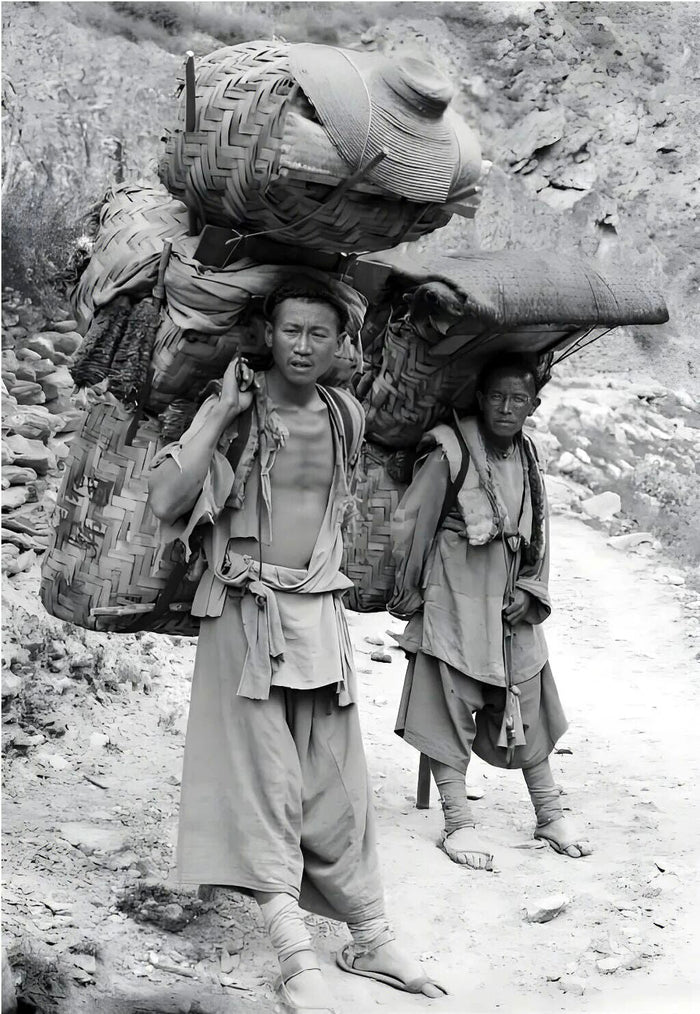
The custom of compressing tea dates back over a millennium. When caravans on the Tea Horse Road left Yunnan for Tibet, Mongolia, or northern China, they carried tons of tea on muleback. Loose tea was bulky, fragile, and difficult to protect. Compressing the leaves into cakes or bricks reduced volume, made loading easier, and protected the tea from humidity and wind during weeks of travel through the mountains.
But compression has a side effect that proved to be far more interesting than mere transport convenience: it slows down aging. By limiting contact between the leaves and outside air, compression creates a micro-environment where fermentation occurs more slowly, more uniformly, and more deeply than with loose leaf. This is why cakes last longer than loose leaf, and why the compressed form has remained the standard for Pu'er, even after caravans gave way to trucks. The history of compressed tea in China is inseparable from that of Pu'er.
The bing cha cake
This is the most famous and widespread form. A flat, round disc, usually weighing 357 grams – a weight that is anything but arbitrary. Seven cakes form a tong (筒), a 2.5-kilogram roll wrapped in bamboo leaves. Twelve rolls make a jian (件), the standard shipping crate. This arithmetic dates back to imperial times, when tea was taxed and transported in standardized units.
The cake is individually wrapped in paper, traditionally handmade paper that allows the tea to breathe while protecting it. This is the ideal form for long-term aging: the flat surface and moderate compression allow for regular air exchange throughout the cake. It is also the form best suited for progressive tasting: a piece is broken off with a tea pick, weighed, steeped, and the rest continues to age.

The zhuan cha brick
Rectangular, often weighing 250 grams, the brick is the oldest form of compressed tea. Its compact size optimizes storage space – bricks stack perfectly, making them the preferred shape for caravanners. For centuries, tea bricks even served as currency in China's border regions, where tea was worth more than money.
The compression of a brick is generally tighter than that of a cake, which further slows down aging. This form is particularly well suited for long-term storage. Breaking off the leaves requires a little more force, but the result in the cup does not fundamentally differ from that of a cake of the same tea.
The tuo cha tuo
The tuo cha (沱茶) is a bird's nest shape – an inverted bowl, hollow underneath, solid on top. Common sizes range from 100 to 250 grams, but there are also mini-tuos of 3 to 5 grams, pre-portioned for a single infusion. The name is said to come from the word tuan (团, round) or, according to another etymology, from the river port of Tuojiang from which the tea was shipped.
The tuo has an interesting characteristic for aging: its compact shape and internal hollow create two different compression zones – the very dense core of the tuo ages more slowly than the outer surface. After a few years, the same tuo can offer two different nuances depending on whether it is taken from the surface or from the deeper part.
Loose leaf san cha
Loose leaf is simply maocha as is – sun-dried leaves, without compression. This is the most practical form for daily use: no tea pick needed, no cake to break, just scoop directly. It is also the form that best reveals the visual quality of the leaf – you can see the bud, the down, the twist, the color. To learn how these leaves go from tree to cup, our article on Pu'er production traces the complete journey.
However, loose leaf ages faster and less uniformly than compressed tea, because each leaf is individually exposed to the air. For a tea intended to be drunk within months or years, this is irrelevant. For a tea you want to keep for twenty years, the cake or tuo will be better companions.
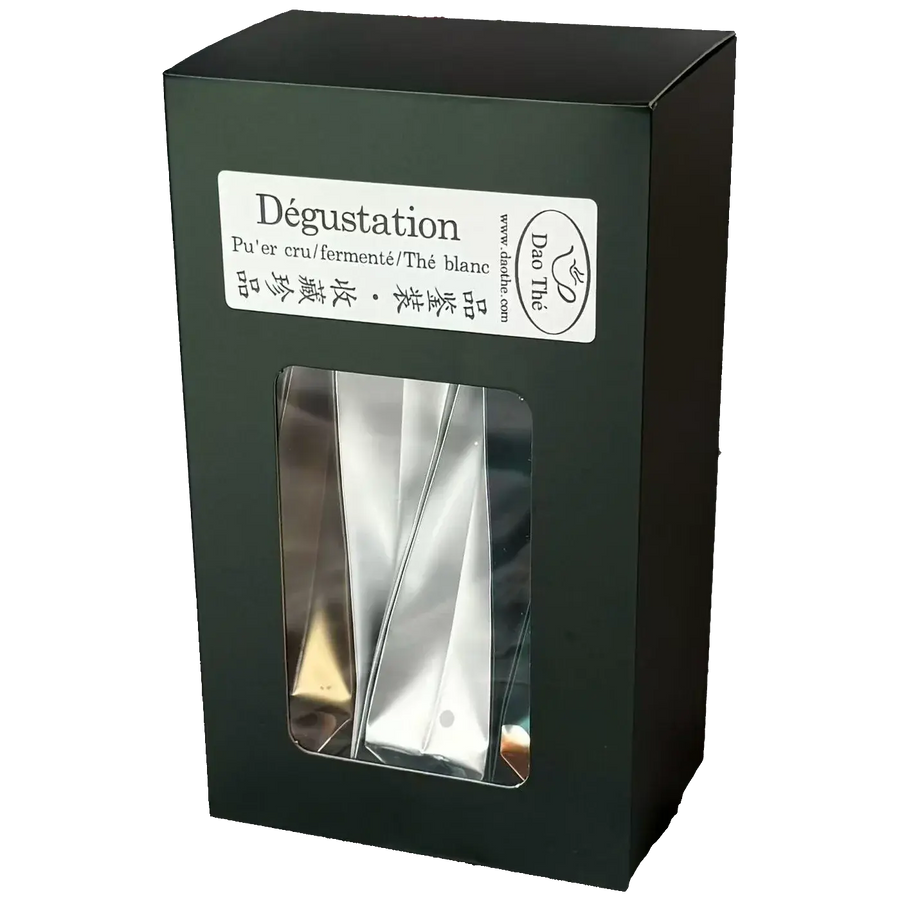
Our Pu'er teas are offered loose leaf – this is a deliberate choice for simplicity and practicality. Loose leaf allows for free dosing, immediate tasting, and enjoying the tea without specific equipment. It is the most accessible format for anyone who wants to integrate Pu'er into their daily life. The Gongfu Cha method also adapts perfectly to loose leaf as well as compressed forms.
Summary
| Form | Chinese Name | Common Weight | Aging | Usage |
|---|---|---|---|---|
| Cake | Bing cha | 357 g | Ideal, regular | Collecting, tasting |
| Brick | Zhuan cha | 250 g | Slow, tight compression | Long-term storage |
| Tuo | Tuo cha | 100–250 g | Variable (core/surface) | Daily, discovery |
| Loose leaf | San cha | Variable | Fast, irregular | Daily, practical |
Frequently Asked Questions
What is the difference between a cake and a tuo?
A cake (bing) is a flat, round disc of 357 grams, compressed into a thin layer. A tuo is a bowl-shaped nest, usually smaller (100 to 250 g), more tightly compressed. The tuo ages a little differently; its dense compression slows down the transformation, but both forms produce excellent results long-term.
Is loose leaf tea of lower quality than cake tea?
No. Loose leaf and cake tea can contain exactly the same leaves. The difference is in preservation: loose leaf ages faster because air circulates freely around the leaves. If you drink your tea within months of purchase, loose leaf is a practical and economical choice. If you want to keep it for several years, cake tea is more suitable.
How many cups can you make from a 357 g cake?
In Gongfu Cha (5 to 7 grams per session of 10 to 15 infusions), a 357 g cake represents about 50 to 70 tasting sessions. Each session yields 10 to 15 small cups, totaling between 500 and 1,000 cups. Compared to the price, Pu'er is one of the most economical teas per cup.