Gongfu Cha 工夫茶 literally means "making tea with skill." Not a ceremony, not a show: it's a brewing method originating in southern China, which involves steeping a small amount of water with many leaves, and repeating the process. Each infusion yields a different tea. It is the finest way to experience a Pu'er, and the method we practice daily.


Why Gongfu Cha is suitable for Pu'er
A Pu'er is a dense tea, compressed for years, rich in soluble substances, capable of yielding ten, fifteen, sometimes twenty infusions. Brewing it in a large mug like a tea bag is like hearing only one note from an entire orchestra.
Gongfu Cha works differently: a small volume of water, a short brewing time, and then you repeat. The first infusion is lively and light. The third reveals the body of the tea. The sixth unfolds deep notes that the first infusions did not hint at. Pu'er changes with each infusion, and Gongfu Cha is the method that makes this journey audible.
What you need
The basic equipment fits on a thirty-centimeter tray. Four items are enough to start.
The gaiwan: a lidded bowl, usually porcelain, with a capacity of 100 to 150 ml. It is the most versatile instrument: neutral, it retains nothing and lets the tea express itself as it is. Ideal for discovering a Pu'er you don't yet know, or for comparing two vintages side by side.

The Yixing teapot: a small unglazed stoneware teapot, crafted from zisha (紫砂, "purple clay") from Yixing city, Jiangsu. Its clay is microscopically porous: with each infusion, it absorbs some of the tea's oils and releases them over time. A well-seasoned Yixing softens tannins, rounds out the liquor, and adds a depth that porcelain does not provide. But it must be dedicated to a single type of tea: one teapot for raw Pu'er, another for fermented. Mixing them blurs the memory of the clay.
The cha hai (茶海), sometimes called "fairness pitcher": a small glass or porcelain pitcher into which the gaiwan is emptied after each infusion. It homogenizes the liquor: the first, lighter drops mix with the last, more concentrated ones. The tea is then served from the cha hai into the cups.
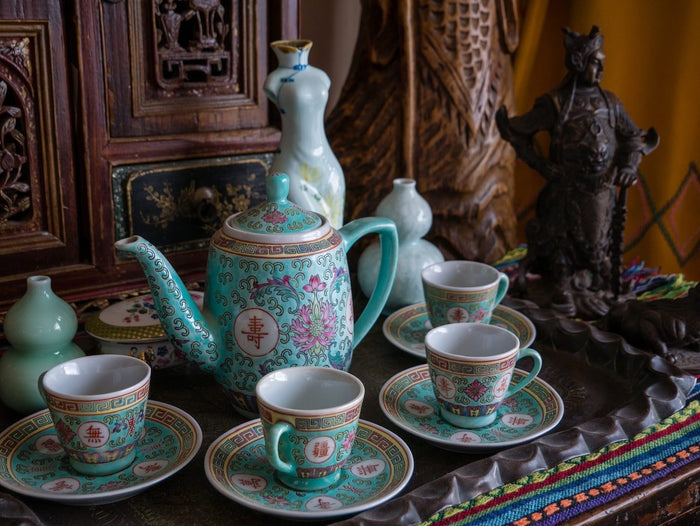
The cups: small, 30 to 50 ml, made of fine porcelain. You drink little with each infusion, but often. The pleasure is not in the quantity, but in the attention paid to each sip.
What about the tray? The cha pan (茶盘) is a hollowed or perforated tray that collects the water poured during rinsing and warming of utensils. Practical but not essential; a simple cloth or a deep saucer will do at first.
Preparation, step by step
1. Heat the utensils. Pour boiling water into the gaiwan (or teapot), then into the cha hai, then into the cups. Empty. This step is not decorative: it brings the ceramic to temperature and prevents the first infusion from cooling upon contact with a cold bowl. The difference is felt from the first sip.
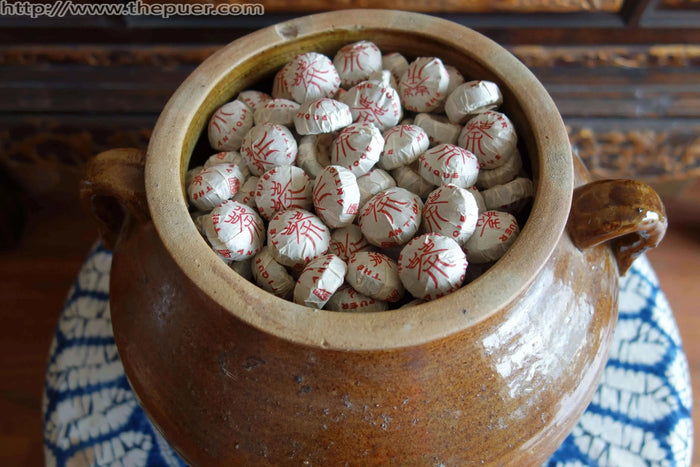
2. Measure the leaves. Count about 5 to 7 grams for a 100 to 120 ml gaiwan. If the Pu'er is compressed into a cake, carefully detach the leaves with a tea pick (cha zhen) following the layers, without breaking the leaves—a patient gesture that preserves their integrity and ensures a cleaner infusion.

3. Rinse the leaves. Pour hot water over the leaves, cover, wait five to ten seconds, then discard this first water. This rinse, called xǐ chá (洗茶), "washing the tea," is not for cleaning: it awakens the leaves, opens them, and prepares them to release their substance. For a heavily compressed or very old Pu'er, two short rinses may be necessary.
4. First infusion. Pour water at 95 °C for young raw Pu'er, or at a full boil (100 °C) for fermented or aged raw Pu'er. Cover. Steep for eight to fifteen seconds. Pour entirely into the cha hai—leave nothing in the gaiwan, otherwise the leaves will continue to steep and the next infusion will be unbalanced. Serve from the cha hai.
5. Subsequent infusions. Repeat the process, adding five to ten seconds to each infusion. A quality Pu'er easily yields ten to fifteen infusions. Around the eighth or ninth, significantly extend the time—thirty, forty seconds, or even more, to extract the last layers of flavor.
What changes from one infusion to the next. The first infusions release the most soluble compounds: light aromas, freshness, liveliness. The middle infusions deliver the body, thickness, and sweetness. The last ones reveal the tea's depth: woody, mineral notes, sometimes a long-lasting warmth that remains in the mouth. It is often here that great Pu'er teas distinguish themselves from good ones.
Water: the detail that changes everything
We dedicated an entire article to the question of water; it deserves this emphasis. Remember the essentials: low-mineral spring water, brought to the correct temperature, changes the result more than precise gram-by-gram dosing. Tap water, filtered or not, often flattens the nuances that Gongfu Cha is precisely designed to reveal.
Gaiwan or Yixing: how to choose
The gaiwan is a mirror; it reflects the tea without adding anything to it. It is the right tool for evaluating an unknown tea, comparing two harvests, or simply seeking transparency. Porcelain is unforgiving: if the tea is mediocre, you will know it.
The Yixing teapot is a companion; it evolves with the tea entrusted to it. After a few months of regular use, the zisha clay absorbs enough oils for the liquor to gain roundness, depth, and sweetness. A good Yixing dedicated to fermented Pu'er for several years yields a result that no other utensil can replicate.
Our advice: start with a simple, inexpensive white porcelain gaiwan. Once you find the type of Pu'er that resonates with you—raw or fermented, young or aged—it will be time to give it its own teapot.
The gestures that matter
Gongfu Cha is not a rigid protocol; it's about precision. Here are some key daily tips.
Pour in a circle. When pouring water into the gaiwan, use a circular motion to wet all the leaves evenly. A concentrated stream in the center creates uneven extraction—some leaves over-steep, others remain dry.
Empty completely. After each infusion, tilt the gaiwan until the last drop. Any remaining water at the bottom continues to extract, and the leaves macerate instead of infusing. The next infusion will show this: bitterness, astringency, loss of clarity.
Observe the leaves. After a few infusions, lift the lid and inhale. The aroma of the wet leaves (the "gaiwan bottom") tells as much as the liquor: if it is floral and long-lasting, the tea still has much to give; if it weakens and simplifies, you are approaching the final infusions.
Don't rush. Between infusions, take time to taste, to smell, to let the retro-olfaction settle in. Gongfu Cha is a slow method in a fast world—that is precisely its appeal.
A word on origins
The term gōngfū (工夫) means "care taken in a gesture," "mastery acquired through practice." The method originated in the Chaozhou (Chaoshan) region of Guangdong, probably around the 18th century, initially for Wuyi oolongs. It then spread throughout China, adapted to each type of tea. Today, in China, it is the most common way to prepare quality tea and the only one that truly does justice to the ancient tree Pu'er we work with in the mountains of Mengku and Bingdao.

Frequently Asked Questions
What exactly is Gongfu Cha?
Gongfu Cha is a tea preparation method originating in southern China, which involves infusing a generous amount of leaves in a small volume of water (gaiwan or Yixing teapot of 100 to 150 ml), for only a few seconds, and repeating the process ten to fifteen times. Each infusion reveals a different facet of the tea. It is not a ceremony; it is the most precise way to prepare quality tea.
Gaiwan or Yixing teapot: which to choose for beginners?
The porcelain gaiwan is the ideal tool to start with. Neutral and inexpensive, it reflects the tea without adding anything and allows you to objectively compare different Pu'er teas. The Yixing teapot, made of porous clay, gradually absorbs the tea's oils and enhances the liquor over months—but it must be dedicated to a single type of tea. It's better to first explore with a gaiwan, then offer a Yixing to the Pu'er that has won you over.
How many infusions can you get from a Pu'er with Gongfu Cha?
A quality Pu'er easily yields ten to fifteen infusions, sometimes more for an ancient tree tea. Each infusion evolves: the first are lively and light, the middle ones deliver the body and sweetness, the last ones reveal the tea's depth—woody, mineral notes, sometimes a long-lasting warmth. This progression is what makes the method interesting.
Practical Summary
Dosing: 5 to 7 g for 100-120 ml
Water: 95 °C (young raw Pu'er) 100 °C (fermented or aged raw Pu'er)
Rinsing: 1 to 2 infusions of 5 to 10 seconds, discard water
First infusion: 8 to 15 seconds
Subsequent infusions: +5 to 10 s per infusion
Number of infusions: 10 to 15 for a quality Pu'er