Pu'er carries a whole vocabulary from Yunnan: names of mountains, workshop gestures, tasting words heard in Chinese tea houses and found, sometimes misspelled, on packaging. Here is a complete glossary with Chinese characters, pinyin, French, and English to put the right word on everything, from the history of tea to the cup.
This glossary follows the journey of Pu'er (also spelled pu'erh or pu-erh – we'll come back to this below): its history and terroirs, its harvest, its production, the two main families of raw and fermented, its forms, its preparation, its tasting, and its aging. Each section can be read alone; together, they form the essential vocabulary of this millennial Chinese tea.
SUMMARY
1. History & origin · 2. Terroir & botany · 3. Harvest & leaf · 4. Production · 5. Raw & fermented (sheng / shou) · 6. Forms & packaging · 7. Preparation & utensils · 8. Tasting · 9. Aging & storage · Pu'er or pu'erh?
1. History & origin
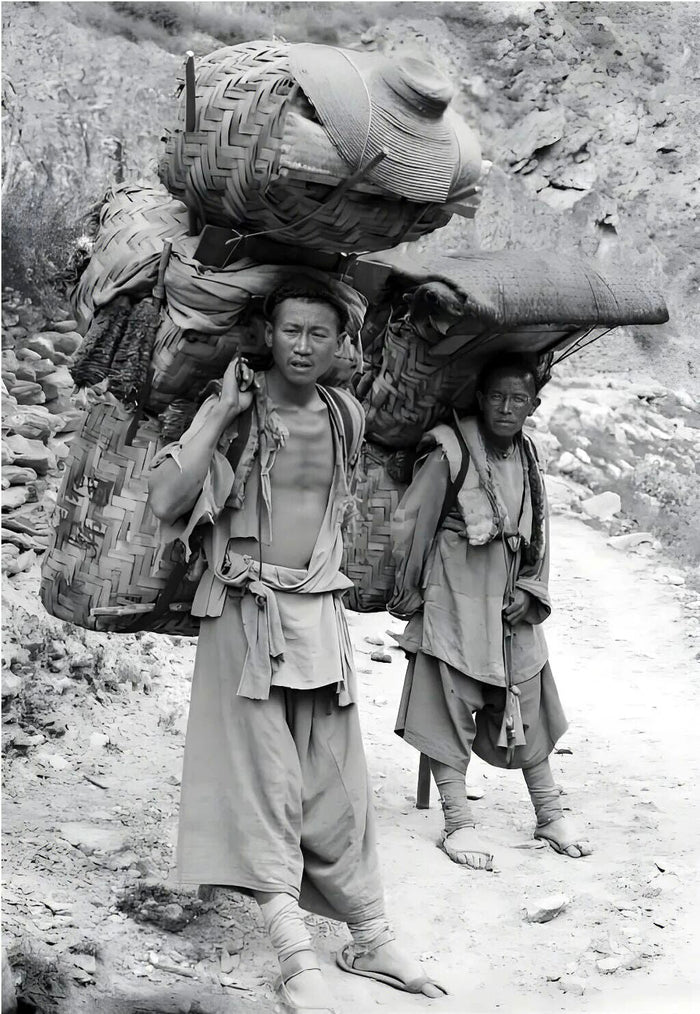
Pu'er takes its name from a city in Yunnan where tea was once traded. It is the starting point for the great caravans of the Ancient Tea Horse Road, and the birthplace of a tradition that we trace in our history of tea.
| Chinese | Pinyin | French | English | Meaning / Usage |
|---|---|---|---|---|
| 普洱 | Pǔ'ěr | Pu'er | Pu'er / Pu-erh | City and region of Yunnan; by extension, the tea. |
| 普洱茶 | Pǔ'ěr chá | Pu'er tea | Pu'er tea | The post-fermented tea of Yunnan as a whole. |
| 云南 | Yúnnán | Yunnan | Yunnan | Southwestern province, birthplace of Pu'er. |
| 茶马古道 | Chá mǎ gǔ dào | Tea Horse Road | Ancient Tea Horse Road | Caravan network that exported tea to Tibet. |
| 西双版纳 | Xīshuāngbǎnnà | Xishuangbanna | Xishuangbanna | Producing prefecture (Yiwu, Menghai...). |
| 临沧 | Líncāng | Lincang | Lincang | Northwestern prefecture (Mengku, Bingdao) where our teas come from. |
| 贡茶 | Gòng chá | Tribute tea | Tribute tea | Tea offered to the imperial court, a guarantee of quality. |
| 七子饼 | Qī zǐ bǐng | Seven Sons cake | Seven Sons cake | Traditional package of seven stacked cakes. |
| 号级茶 | Hào jí chá | "House" teas | Antique-era tea | Pu'er from before 1950, era of old tea houses. |
2. Terroir & botany
The big deal with Pu'er is the tree and the mountain it comes from. Everything changes between ancient tree tea (gushu) and plantation tea; our Yunnan terroirs detail these nuances.
| Chinese | Pinyin | French | English | Meaning / Usage |
|---|---|---|---|---|
| 古树 | Gǔ shù | Ancient tree | Old / ancient tree | Old tea tree, often centuries old, in the forest. |
| 古树茶 | Gǔ shù chá | Ancient tree tea | Ancient tree tea | Tea from these old trees; the most sought after. |
| 台地茶 | Tái dì chá | Plantation tea | Terrace / plantation tea | Tea bushes pruned in tight rows, on terraces. |
| 乔木 | Qiáo mù | Arbor tree | Arbor tree | Tea tree allowed to grow as a tree, not pruned into a bush. |
| 野生 | Yě shēng | Wild | Wild | Spontaneous growth, not cultivated. |
| 大叶种 | Dà yè zhǒng | Large-leaf cultivar | Large-leaf varietal | Camellia sinensis var. assamica, basis of Pu'er. |
| 山头 | Shān tóu | Mountain terroir | Mountain / terroir | Village or mountain of origin of a tea. |
| 勐库 | Měng kù | Mengku | Mengku | Renowned region of Lincang. |
| 冰岛 | Bīng dǎo | Bingdao | Bingdao | Famous village in Mengku, highly sought after. |
| 大雪山 | Dà xuě shān | Daxueshan | Daxueshan | "Great Snow Mountain", forests of ancient trees. |
| 老班章 | Lǎo Bānzhāng | Laobanzhang | Laobanzhang | Mythical village in Xishuangbanna, powerful teas. |
| 易武 | Yì wǔ | Yiwu | Yiwu | Historic mountain with sweet and deep teas. |
3. Harvest & leaf
It all starts with the leaf. The time of plucking and the grade of the bud already determine the character of the tea – this is what our article on Pu'er tea harvest explains.
| Chinese | Pinyin | French | English | Meaning / Usage |
|---|---|---|---|---|
| 采茶 | Cǎi chá | Tea plucking | Tea plucking | The harvest, done by hand for fine teas. |
| 春茶 | Chūn chá | Spring tea | Spring tea | The most prized harvest, rich and fragrant. |
| 明前 | Míng qián | Before Qingming | Pre-Qingming | Harvested before early April, the earliest and most delicate. |
| 一芽两叶 | Yī yá liǎng yè | One bud, two leaves | One bud, two leaves | Balanced plucking standard. |
| 芽头 | Yá tóu | Bud | Bud / tip | Young shoot still closed, fine and downy. |
| 茶青 | Chá qīng | Fresh leaf | Fresh leaf | The freshly plucked leaf, before processing. |
| 单株 | Dān zhū | Single tree | Single tree | Tea from a single tree, rare and distinctive. |
4. Production
From fresh leaf to cake, Pu'er undergoes a series of precise steps. We describe them one by one in how Pu'er is made.
| Chinese | Pinyin | French | English | Meaning / Usage |
|---|---|---|---|---|
| 毛茶 | Máo chá | Rough tea | Maocha | Base leaf, starting point for all Pu'er. |
| 杀青 | Shā qīng | Fixation | Kill-green / fixation | Heating that stops the oxidation of the leaves. |
| 揉捻 | Róu niǎn | Rolling | Rolling | The leaf is rolled to release its juices. |
| 晒青 | Shài qīng | Sun-drying | Sun-drying | Sun-drying specific to Pu'er. |
| 晒青毛茶 | Shài qīng máo chá | Sun-dried Maocha | Sun-dried maocha | The sun-dried raw material. |
| 渥堆 | Wò duī | Wet piling | Wet piling | Wet fermentation that creates fermented (shou) Pu'er. |
| 后发酵 | Hòu fā jiào | Post-fermentation | Post-fermentation | Slow fermentation that continues after production. |
| 压饼 | Yā bǐng | Pressing into cake | Pressing into cake | Shaping the tea under pressure. |
| 拼配 | Pīn pèi | Blending | Blending | Marriage of leaves from several origins. |
| 纯料 | Chún liào | Single-origin | Single-origin | Tea from a single origin, unblended. |
5. Raw & Fermented (sheng / shou)
Pu'er is divided into two major families. The distinction is fundamental: we dedicate an entire article to it, Raw Pu'er or Fermented Pu'er.
| Chinese | Pinyin | French | English | Meaning / usage |
|---|---|---|---|---|
| 生茶 | Shēng chá | Raw Pu'er | Raw / sheng Pu'er | Unfermented tea, which ages slowly over time. |
| 熟茶 | Shú chá (« shou ») | Fermented Pu'er | Ripe / shou Pu'er | Tea with accelerated fermentation, mellow and woody from the outset. |
| 青饼 | Qīng bǐng | Raw cake | Raw cake | Cake of raw Pu'er ("green"). |
| 熟饼 | Shú bǐng | Fermented cake | Ripe cake | Cake of fermented Pu'er. |
| 宫廷 | Gōng tíng | Imperial grade | Palace / imperial grade | The finest grade of fermented Pu'er, all buds. |
6. Shapes & Packaging
Cake, brick, nest or loose: Pu'er takes a thousand forms, inherited from the necessities of transport as much as from taste. Our article on the forms of Pu'er reviews them.
| Chinese | Pinyin | French | English | Meaning / usage |
|---|---|---|---|---|
| 饼茶 | Bǐng chá | Tea cake | Cake / bing tea | Compressed disc, the most common form (often 357g). |
| 砖茶 | Zhuān chá | Brick tea | Brick tea | Tea pressed into a rectangular block. |
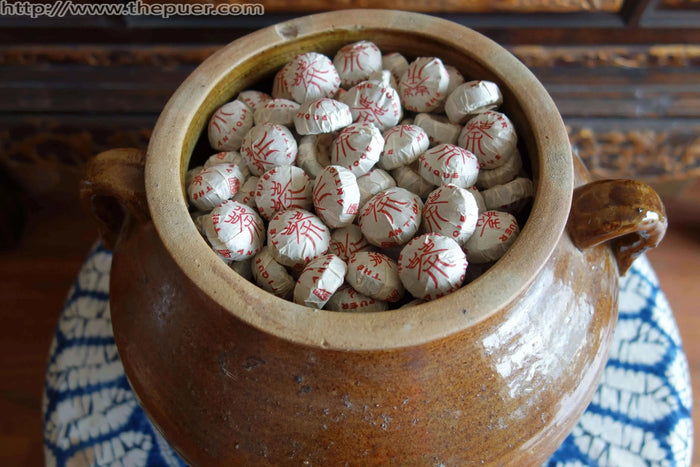
| 沱茶 | Tuó chá | Tuocha (nest) | Tuo / nest tea | Small rounded bowl, shaped like a nest. |
| 金瓜 | Jīn guā | Golden melon | Golden melon | Large rounded shape, inherited from tribute teas. |
| 龙珠 | Lóng zhū | Dragon pearl | Dragon pearl | Small ball for individual infusion. |
| 散茶 | Sǎn chá | Loose-leaf tea | Loose-leaf tea | Uncompressed leaves. |
| 棉纸 | Mián zhǐ | Cotton paper | Cotton paper | Traditional packaging that allows the cake to breathe. |
| 筒 | Tǒng | Tong / stack of seven | Tong / stack of seven | Stack of seven cakes wrapped in bamboo leaf. |
7. Preparation & Utensils
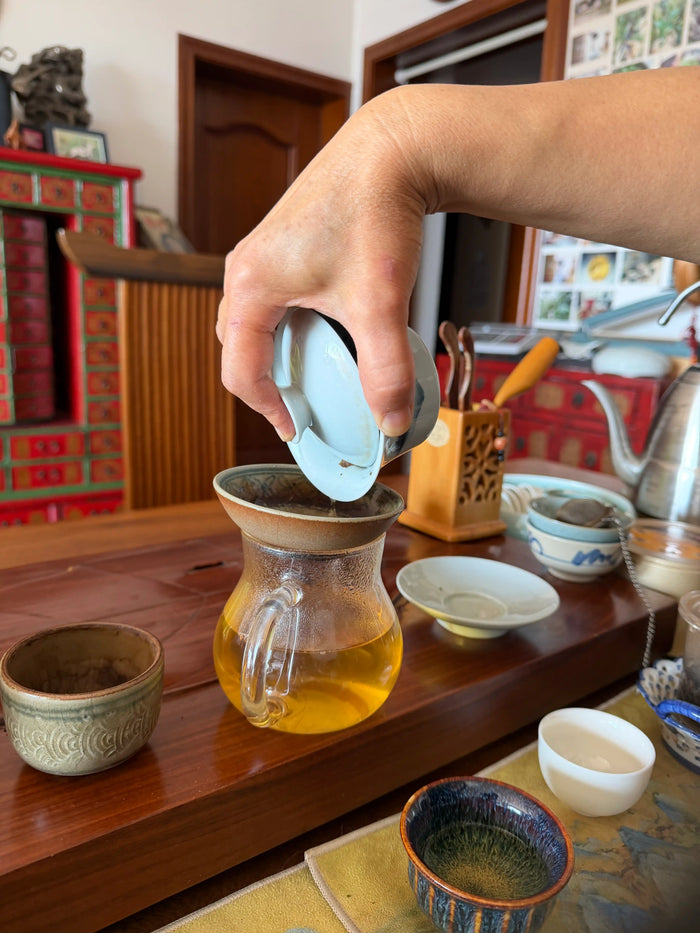
Preparing Pu'er "the Chinese way" is the art of Gongfu Cha: many leaves, little water, short and repeated infusions. Our complete preparation guide details the steps.
| Chinese | Pinyin | French | English | Meaning / usage |
|---|---|---|---|---|
| 工夫茶 | Gōng fu chá | Gongfu cha | Gongfu tea | The art of careful infusion, in small repeated quantities. |
| 盖碗 | Gài wǎn | Gaiwan | Gaiwan / lidded bowl | Lidded bowl, the king of Pu'er utensils. |
| 紫砂壶 | Zǐ shā hú | Yixing teapot | Yixing / zisha pot | Purple clay teapot, ideal for Pu'er. |
| 公道杯 | Gōng dào bēi | Fairness pitcher | Fairness pitcher | Carafe that homogenizes the infusion before serving. |
| 品茗杯 | Pǐn míng bēi | Tasting cup | Tasting cup | Small cup for tasting in small sips. |
| 茶针 / 茶刀 | Chá zhēn / chá dāo | Tea needle / knife | Pu'er pick / knife | Tool for separating the cake without breaking the leaf. |
| 洗茶 | Xǐ chá | Tea rinse | Tea rinse | Very quick first infusion, which is discarded. |
| 醒茶 | Xǐng chá | Awakening the tea | Awakening the tea | Aerating the leaf so it opens before infusion. |
| 出汤 | Chū tāng | Pouring out the infusion | Pouring out | Removing the liquor at the right time, without letting it linger. |
| 水温 | Shuǐ wēn | Water temperature | Water temperature | For Pu'er, very hot water (95-100 °C). See Pu'er water. |
8. Tasting
Chinese has very subtle words to describe sensations that are sometimes difficult to name in English. Here are some of the most beautiful.
| Chinese | Pinyin | French | English | Meaning / usage |
|---|---|---|---|---|
| 茶汤 | Chá tāng | Liquor | Tea liquor | The infusion itself, the liquid in the cup. |
| 汤色 | Tāng sè | Liquor color | Liquor color | From light gold (young raw) to mahogany (fermented). |
| 回甘 | Huí gān | Returning sweetness | Returning sweetness | Sweetness that returns to the mouth after sipping. |
| 生津 | Shēng jīn | Salivation | Mouth-watering | Sensation of mouth-watering, a sign of a beautiful tea. |
| 喉韵 | Hóu yùn | Throat resonance | Throat feel | Length and sensation left at the back of the throat. |
| 茶气 | Chá qì | Tea energy | Tea energy (qi) | The almost bodily strength felt when tasting. |
| 陈香 | Chén xiāng | Aged aroma | Aged aroma | Old, woody, and sweet notes of mature Pu'er. |
| 苦 / 涩 | Kǔ / Sè | Bitterness / astringency | Bitterness / astringency | Two sensations that, when well-balanced, structure the tea. |
| 叶底 | Yè dǐ | Infused leaves | Spent / wet leaves | The "leaf bed" that is examined after infusion. |
9. Aging & Storage
Time is an ingredient in Pu'er. How it is kept determines what it will become, a topic we explore in aging your Pu'er.
| Chinese | Pinyin | French | English | Meaning / Usage |
|---|---|---|---|---|
| 陈化 | Chén huà | Aging | Aging | Slow maturation that improves tea over the years. |
| 仓储 | Cāng chǔ | Storage | Storage | The storage conditions for Pu'er. |
| 干仓 | Gān cāng | Dry storage | Dry storage | Dry storage, slow and clean aging (most prized). |
| 湿仓 | Shī cāng | Wet storage | Wet storage | Storage in a humid environment, accelerated aging, riskier. |
| 年份 | Nián fèn | Vintage | Vintage | The harvest year of a cake. |
| 越陈越香 | Yuè chén yuè xiāng | The older, the more fragrant | The older, the better | The adage that summarizes the spirit of Pu'er. |
Pu'er, pu'erh, pu-erh: why so many spellings?
On packaging, in shops, and online, the same tea is spelled in a thousand ways: Pu'er, pu'erh, pu-erh, puerh, pu er, sometimes even bolay or po lei (the Cantonese pronunciation). All refer to the same thing: Yunnan tea, written 普洱 in Chinese.
The explanation lies in the transcription. The Chinese word 普洱 is pronounced Pǔ'ěr in pinyin, the official system for romanizing Mandarin. The apostrophe merely serves to clearly separate the two syllables, pu and er, hence the spelling Pu'er, which is the most faithful. The h in pu'erh and pu-erh comes from old English transcriptions, predating pinyin, which added an h to render the final sound; its use remains widespread in the Anglophone world. As for the hyphen in pu-erh, it is an English typographical custom.
In summary: Pu'er is the most accurate spelling (pinyin); pu'erh and pu-erh are Anglophone variants that are also correct in common usage. All refer to the same 普洱.
At Daothé, we write Pu'er, in fidelity to pinyin, but we respond to the same name under all its spellings.
Frequently asked questions about Pu'er vocabulary
Pu'er or pu'erh: which is the correct spelling?
Both are accepted. Pu'er follows pinyin, the official system for romanizing Chinese (普洱 is pronounced Pǔ'ěr), where the apostrophe separates the syllables pu and er. Pu'erh and pu-erh, with an h, come from older Anglophone transcriptions and remain very common. All refer to the same Yunnan tea.
What do sheng and shou mean?
Sheng (生, "raw") refers to raw Pu'er, unfermented, which ages slowly over time. Shou (熟, "ripe," pronounced shú in pinyin) refers to fermented Pu'er, which has undergone accelerated fermentation in a workshop. We compare the two in our article Raw or fermented Pu'er.
What is gushu?
Gushu (古树) literally means "old tree." A gushu tea comes from ancient tea trees, often centuries old, that grow in the forest as opposed to plantation teas (台地茶, taidicha). The leaves gain in concentration and complexity.
What does "hui gan" mean in tea tasting?
Hui gan (回甘), the "return of sweetness," refers to the sweet taste that lingers in the mouth a few moments after a sip, once the bitterness has passed. It is one of the desired signs of a fine Pu'er, just like sheng jin (生津), the sensation of the mouth salivating.
What is a bing cha?
Bing cha (饼茶) is the tea cake, the most common form of Pu'er—a compressed disc, often weighing 357g. Tea is also available in brick (zhuan cha), nest (tuocha), or loose-leaf (san cha) forms. We detail all of this in the forms of Pu'er.
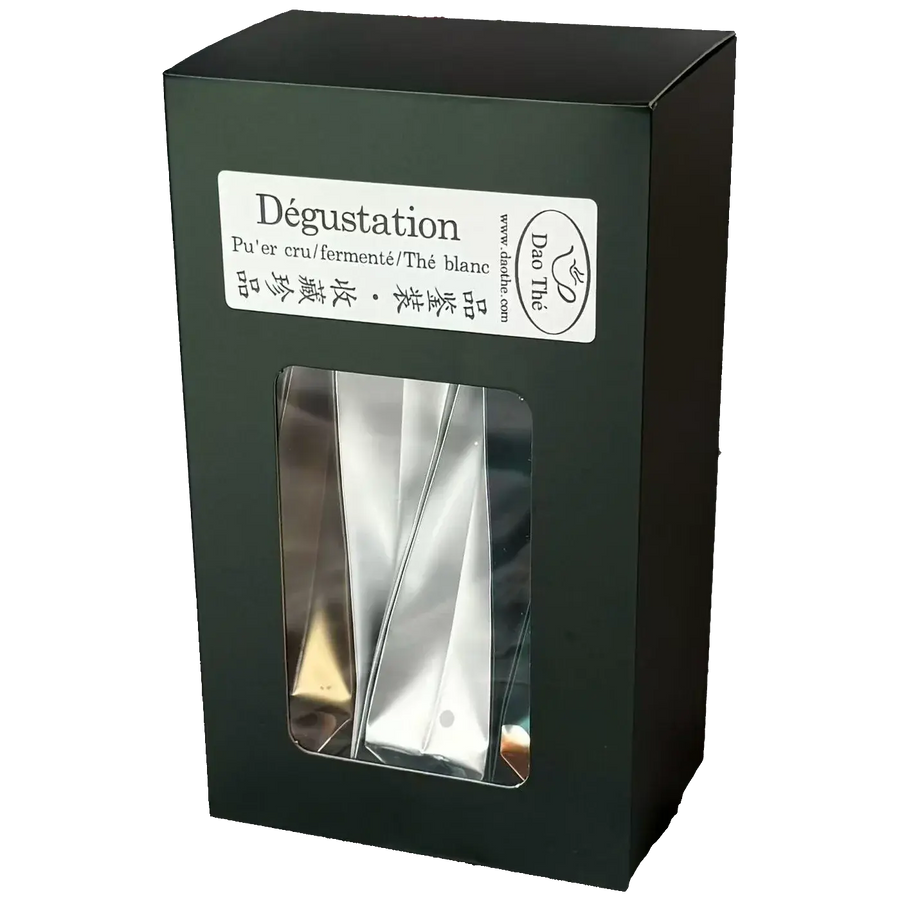
Now that the words are laid out, the best thing to do is taste. Our Discovery Set brings together three Yunnan teas to put a flavor to each of these terms.
To learn more: What is Pu'er Tea? and How to Choose Your First Pu'er.