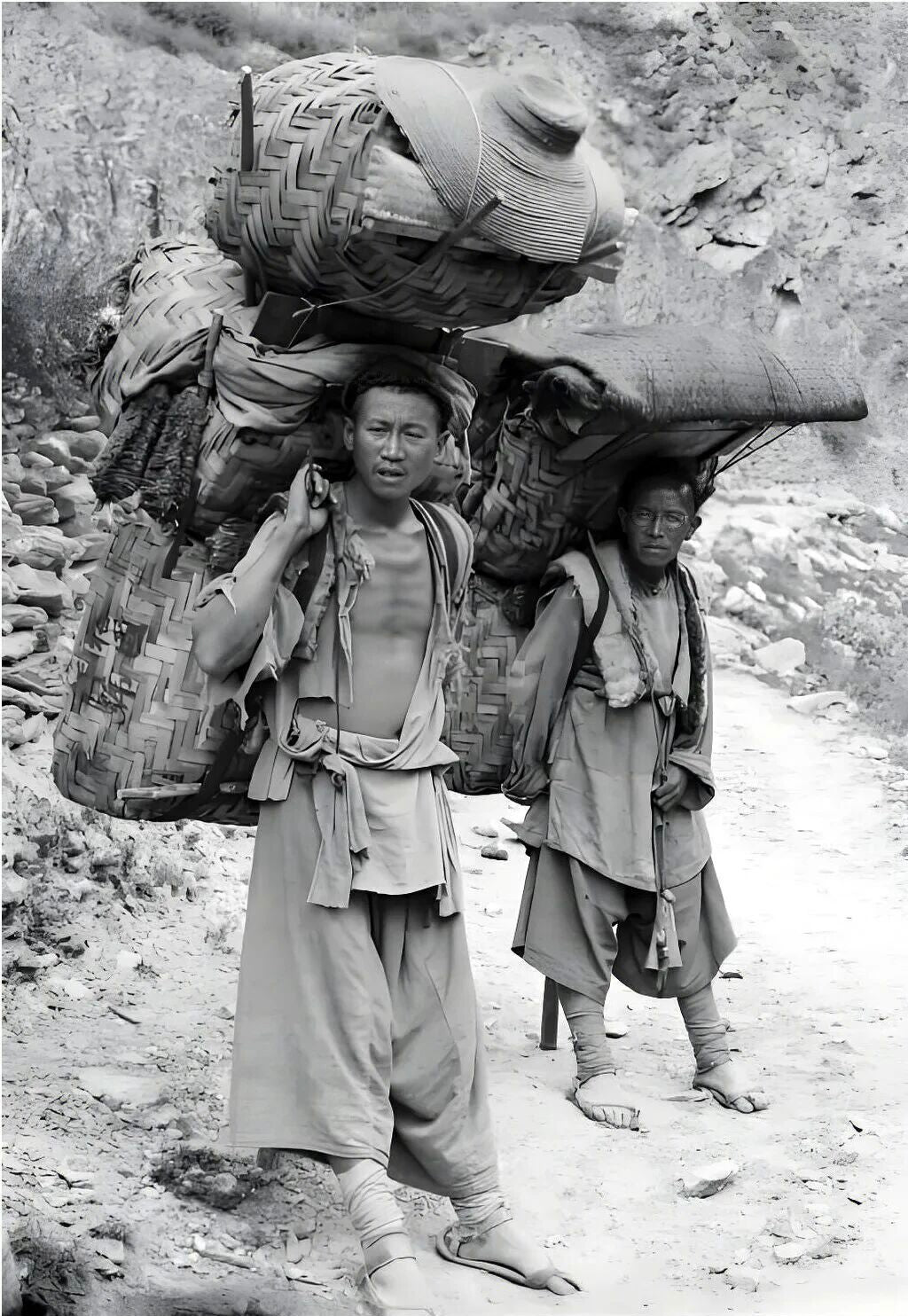
Before roads, before trucks, even before maps, there were mountain trails, mules, and men who walked. For over a thousand years, Yunnan tea traveled on animal backs to Tibet, Mongolia, and beyond, along a network of paths now known as the Cha Ma Gu Dao – the Tea Horse Road. This road is not folklore; it explains why Pu'er exists in the form we know it today.

Tea for Horses
The principle was simple and vital for both sides. Tibetans, nomads of the high plateaus, needed tea: their diet, rich in meat, butter, and dairy products, called for a drink capable of aiding digestion, and tea had become, over centuries, an indispensable part of their daily lives. The Chinese, for their part, needed robust horses for their armies, and the Tibetan ponies—small, resilient, accustomed to high altitudes—were the best available.
The trade of tea for horses is documented as early as the Tang Dynasty in the 7th century. It intensified under the Song, then reached its peak under the Ming, between the 14th and 17th centuries. At that time, a horse could be exchanged for 200 to 450 kilograms of tea, depending on the quality of the mount. Tea was not a luxury; it was currency, a strategic commodity, a diplomatic lever between empires.
Three Thousand Kilometers by Muleback
The Cha Ma Gu Dao was not a single road but a network of trails that snaked through the mountains of southwestern China. The main branch started from Yunnan, from Yiwu and the city of Pu'er, in the heart of the producing regions, and climbed northwest, passing through Dali, Lijiang, Shangri-La, before crossing the Himalayan passes to reach Lhasa. Approximately 3,000 kilometers of mountain trails, narrow gorges, and suspension bridges over dizzying ravines.
Caravans consisted of mules and packhorses, sometimes yaks in the highest sections. Each animal carried between 60 and 90 kilograms of compressed tea. Human porters, in sections too narrow for animals, sometimes carried more than their own weight on their backs. A one-way trip took several months. The Sichuan branch, the other major trade route, starting from the city of Ya'an, covered more than 2,000 kilometers and required an eight-month journey.
This was not a journey for the faint of heart. Caravans moved at the pace of the animals, the seasons, and the passes. Monsoon rains rendered some passages impassable for weeks. Snow closed high-altitude passes for several months a year. And yet, for over a millennium, tea continued to travel to Tibet because it had to.

What the Road Did to the Tea
The Cha Ma Gu Dao didn't just transport Pu'er; it shaped it. Several fundamental characteristics of Pu'er as we know it today arose directly from the constraints of the journey.
Compression
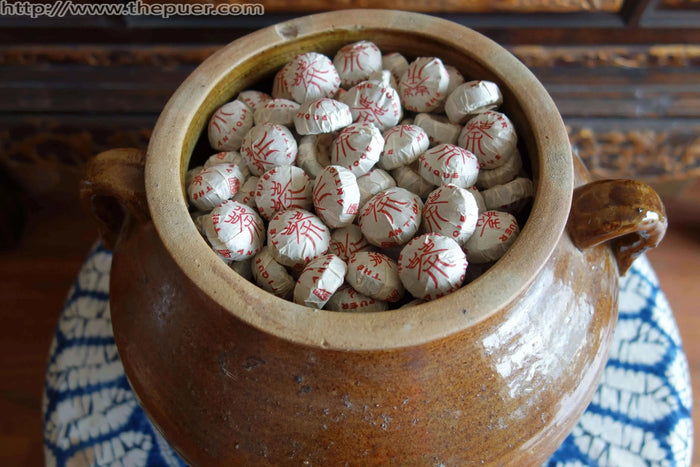
Loose-leaf tea was too bulky and fragile to travel on muleback for months. Compressing the leaves into cakes, bricks, or balls reduced volume, made loading easier, and protected the tea from the elements. It was the road that invented the cake, not aesthetics. We detail each of these compression forms in a dedicated article.
Fermentation
During months of travel through humid and warm areas, the cakes continued to transform. The ambient humidity, the daytime heat, the morning dew—all activated a slow, involuntary fermentation that profoundly altered the tea along the way. When the cakes arrived in Tibet, they were no longer the same as those that had left Yunnan. And Tibetans came to prefer this tea transformed by the journey over freshly produced tea. This is probably how people understood that Pu'er improves with age—an accident that became an art, which we explore in our article on aging Pu'er.
The Name
Yunnan tea was produced in many different mountains, but it converged at a large trading post: the city of Pu'er (formerly Simao). It was there that caravans formed, tea was packaged and taxed, and the journey began. The tea that passed through Pu'er took the city's name, and that is how "Pu'er" became the generic name for a whole world of teas.
The City of Pu'er: The Trading Post Where It All Began
Pu'er was not a tea mountain; it was a crossroads. Leaves descended from the mountains of Xishuangbanna and Lincang to this market city, where they were sorted, assembled, compressed, and packed for the journey. Merchants negotiated, muleteers loaded, caravans set off.
Under the Qing dynasty, in 1744, Emperor Qianlong formalized the tribute tea system: six mountains in Xishuangbanna were designated to supply tea for the imperial court in Beijing. This tribute tea also passed through Pu'er, which further cemented the city's reputation and that of the tea bearing its name. Among the mountains that supplied this tribute tea, some still house centuries-old ancient trees today.
The Road Today
Caravans disappeared in the second half of the 20th century, replaced by modern roads. But the Cha Ma Gu Dao has not completely vanished. Paved sections remain in the mountains, worn smooth by centuries of hooves and sandals. Some staging villages are still inhabited by the descendants of the muleteers. And in the Mengku mountains where we work, the trails connecting tea gardens to villages sometimes unknowingly follow the route of the ancient paths. We have, while climbing to the gardens, stepped on flagstones polished by centuries of hooves—one doesn't quite walk the same way afterwards.
What primarily remains of the road is the tea itself. The compressed cake, aging as an art, the idea that tea can transcend time and improve along the way—all of this was born on these mountain trails, between Yunnan and Tibet, over a thousand years ago. When you hold a Pu'er cake in your hands, you hold an object whose form was invented by muleteers, whose fermentation was discovered by accident, and whose name comes from a market town where men from all the mountains of Yunnan converged. History is not behind the tea; it is within it. To understand how these leaves go from bud to cake, our article on Pu'er production traces each step.

Frequently Asked Questions
What is the Cha Ma Gu Dao?
The Cha Ma Gu Dao (茶马古道), or "Ancient Tea Horse Road," is a network of caravan trails that connected Yunnan to Tibet, Sichuan, and Southeast Asia. For over a millennium, caravans of horses and mules transported compressed tea along it, exchanged for Tibetan horses. It is one of the oldest trade routes in the world.
Where does Pu'er tea get its name?
Pu'er (or pu'erh) gets its name from the city of Pu'er in Yunnan, which was not a tea mountain itself but the main trading post where leaves from all the surrounding mountains converged. It was there that tea was sorted, compressed, taxed, and loaded onto caravans. The tea that left Pu'er eventually took the city's name.
Why was Pu'er compressed into cakes for transport?
Compression reduced volume, made loading onto mules easier, and protected the tea from the elements during weeks of travel. But it also had an unexpected effect: enclosed in the cake, the leaves slowly transformed during transport, developing flavors that loose-leaf tea would never have produced. The aging of Pu'er was born on these trails.
How long has Pu'er existed?
Tea has been drunk in Yunnan for nearly two thousand years, and the tea-for-horses trade is documented as early as the Tang Dynasty (7th century). Pu'er as we know it—compressed, aged, traveling—was forged over this millennium of caravans, before being codified under the Ming and Qing dynasties.
Does the Tea Horse Road still exist?
As a trade route, no; trucks replaced mules starting in the 1950s. But some sections have been preserved and classified as heritage sites, and the trails remain visible in the Yunnan mountains. Several of the villages where we work are located on ancient routes of the Cha Ma Gu Dao.