Pu'er is one of the rare teas in the world that improves with age. While a green tea loses its aromas within a few months, a well-preserved Pu'er gains in depth, roundness, and complexity year after year. This property, unique in the world of tea, makes Pu'er an object of patience and fascination.
Why Pu'er ages
Not all teas are meant to last through time. Green tea, for example, undergoes complete fixation which destroys the enzymes responsible for oxidation: it is fixed, stable, and can only lose its freshness. Pu'er, however, is designed differently. During sha qing, the wok-firing fixation, some of the enzymes are deliberately left active. It is this residual fraction that allows the leaf to continue transforming after production. Our article on Pu'er production details this decisive step.
Sun drying plays an equally decisive role. Less hot than industrial drying, it preserves enzymes and maintains a slight moisture content in the leaf. This residual moisture, combined with active enzymes, creates a favorable environment for slow microbial fermentation—fungi, bacteria, yeasts—which progressively transforms the chemical compounds of the leaf. Bitter tannins degrade, sweet molecules appear, and aromas evolve towards deeper registers. It's a living biological process, comparable to what happens in aged cheese or a fine wine in a cellar.

What changes in the cup
The evolution of Pu'er over time follows an arc that connoisseurs learn to recognize. Let's consider the case of raw (sheng) Pu'er, where aging is most spectacular.
Young (0–5 years)
The liquor is clear, yellow-green. The tea is lively, sometimes bitter, often astringent, with fresh vegetal, herbaceous, floral notes. It's a tea with character that doesn't immediately try to please. Tannins are still very present.
Adolescent (5–15 years)
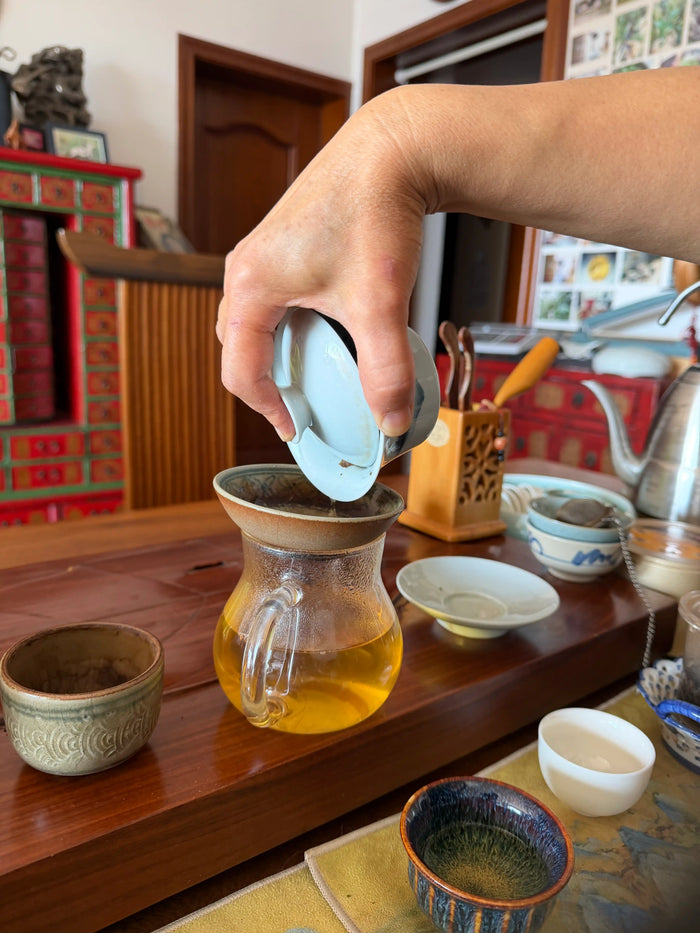
The bitterness begins to recede. The liquor takes on golden, light amber hues. Floral notes evolve towards honey and dried fruit. The tea gains roundness without losing its vibrancy. This is a period of transition where the tea still hesitates between youth and maturity.
Mature (15–30 years)
The transformation is distinct. Tannins have softened, the liquor is dark amber. Aromas evoke seasoned wood, dates, soft leather, and undergrowth after rain. The sweet aftertaste (huigan) is ample and lasting. The tea has gained depth where it lost its bite.
Old (30 years and over)
The liquor is dark, mahogany red, almost black. The aromas are those of time itself: camphor, cool incense, precious wood, ancient earth. Astringency has disappeared. What remains is a dense unctuousness, a lingering finish, and a physical sensation that the Chinese call cha qi—something that is as much about taste as it is about presence.
EVOLUTION OF RAW PU'ER OVER TIME
Dry storage or wet storage
The way Pu'er is stored drastically changes what it becomes. Two major schools of thought exist in the world of Chinese tea, and the difference between them is fundamental.
Dry storage
Dry storage (gan cang, 干仓) involves keeping the tea in a temperate and low-humidity environment, typically 18 to 25 °C, with a relative humidity of 60 to 70 %. The tea evolves slowly, at its own pace. The result is a clean, bright Pu'er with clear aromas and a bright liquor. This is the preferred method for connoisseurs who seek the purity of the tea and fidelity to its original terroir.
Wet storage
Wet storage (shi cang, 湿仓) uses deliberately high humidity, often above 80 %, to accelerate microbial transformation. The tea ages faster, darkens quicker, and develops earthy, peaty, sometimes damp cellar notes. The warehouses of Hong Kong and Guangzhou have long been centers for this method. But the risk is real: poorly controlled humidity can cause mold, and the tea can turn moldy rather than aged.
These are not two versions of the same tea; they are two different teas. A twenty-year-old sheng stored dry and the same sheng stored wet have almost nothing in common. Neither the color, nor the aromas, nor the mouthfeel.
Storing your Pu'er at home
Good news: storing Pu'er at home does not require complicated equipment. A few simple principles are enough for the tea to age under good conditions.
Temperature
Ambient, stable, without sudden changes. Between 18 and 25 °C is ideal. Avoid rooms that alternate between hot and cold: repeated variations push moisture into the leaf and then remove it, which disrupts aging and flattens aromas.
Humidity
Between 60 and 70 % relative humidity. Below 60 %, the leaf dries out too much and aging stops. Above 70 %, the risk of mold increases. A simple hygrometer is sufficient for monitoring.
Odors
Tea absorbs odors from its environment like a sponge. No kitchen, no household products, no perfume nearby. A cupboard, a shelf in a quiet, clean room works very well.
Light
Away from direct light, which degrades aromatic compounds. Darkness is not necessary, but direct sunlight should be avoided.
Ventilation
Tea needs to breathe to age. Do not seal it in a plastic bag or an airtight jar. Its original packaging — paper, bamboo — is usually the best container. If storing in a box, leave it slightly open.

Do all Pu'er teas deserve to age?
No, and this is a question best asked before putting a cake in a cupboard for twenty years. For a Pu'er to age well, three things are needed: quality raw material (leaves rich in compounds that can evolve), sun drying (not electric, otherwise the enzymes are dead and the tea won't change), and careful processing at every stage.
A machine-dried plantation Pu'er has little to gain from aging. It will only age in the banal sense of the word—it will lose freshness without gaining anything in return. However, a well-made Pu'er, from ancient trees, traditionally processed, can last for decades and become something truly extraordinary over time.
Raw Pu'er is the natural candidate for long-term aging. Fermented Pu'er, already deeply transformed by wo dui, also evolves over time—its roundness deepens, its aromas develop a patina—but the gain is less spectacular than for a raw tea, which starts from a more nascent state.
Time, the invisible ingredient
What makes Pu'er aging fascinating is that it cannot be forced. One can provide the right conditions—temperature, humidity, calm—but the transformation itself happens on its own, at the pace of microorganisms and the slow chemistry of the leaf. It is an act of trust in time, and in the tea one has chosen. The compression form—cake, brick, or tuo—directly influences the speed of this transformation.
In the mountains where we work, some families have kept cakes for generations. These are not speculators betting on vintages; they are people who know that today's tea will be better tomorrow, and even better in ten years. It is a patience rooted in experience, not speculation. And this is perhaps the most beautiful lesson that Pu'er teaches: some things only exist if we give them time to happen.

Frequently Asked Questions
How long can Pu'er be aged?
A good quality raw Pu'er can improve for thirty to fifty years, or even longer, if stored under the right conditions. Fermented Pu'er has a shorter window—ten to twenty years—after which it reaches a plateau. In all cases, the initial quality of the leaves and storage conditions matter more than duration.
Is an old Pu'er necessarily better than a young one?
No. Time transforms tea, but does not correct it. A mediocre Pu'er aged twenty years remains mediocre; it will just be different. And a good young Pu'er, well made, offers lively and frank flavors that an aged tea no longer possesses. Young and old are two expressions of the same tea, not two degrees of quality.
How to store Pu'er at home?
Three enemies to avoid: direct light, strong odors, and excessive humidity. A clean cupboard, away from the kitchen and household products, at a stable ambient temperature (18-25 °C) and with a relative humidity of 60 to 70 %, works very well. Keep the tea in its original packaging or in a container that allows the leaves to breathe; never use an airtight box.