Five thousand years, perhaps more. Tea is one of the longest conversations between man and a plant. It began in a forest in Yunnan, and it continues today, in your cup as in ours.

Origins in Yunnan
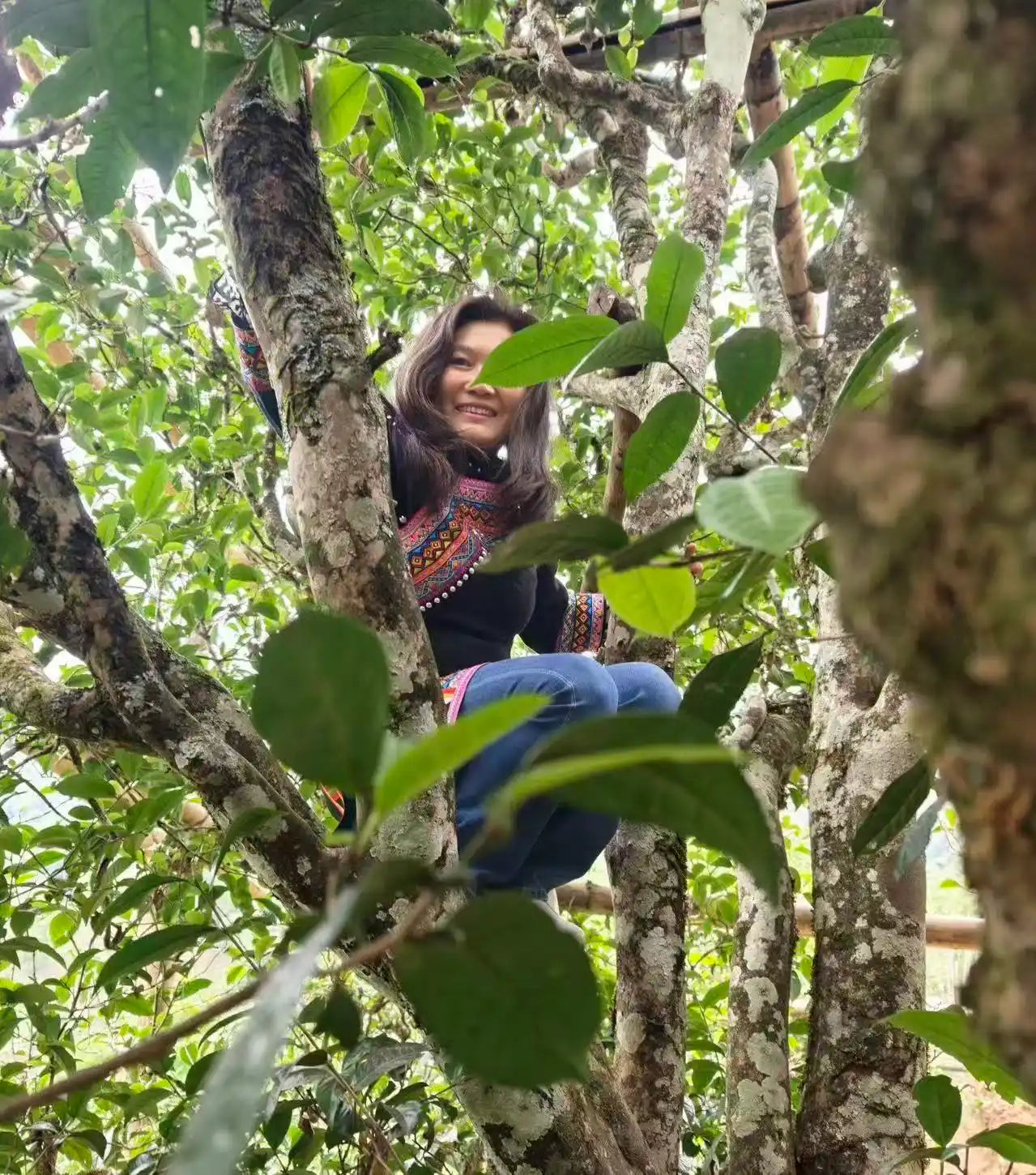
The tea plant Camellia sinensis is native to a forest area that now covers southwestern China. It is in this area that the oldest tea plants in the world still grow, and it is in Yunnan, specifically in the Lincang mountains, that the most impressive of them are found. Some trees are over a thousand years old. And the oldest reaches 3200 years old; it is now protected and no longer harvested. A museum has even been opened in its honor.
This botanical antiquity has a simple consequence: it was there, and probably nowhere else, that early humans encountered tea. Before being a beverage, tea was undoubtedly a chewed leaf, a medicinal plant, a food cooked with other herbs. The minorities of Yunnan: the Bulang, Dai, Hani, Lahu, Wa have preserved traditions to this day where tea is not only drunk but also eaten, fermented into a paste, consumed in forms that classical Chinese civilization eventually forgot.
Yunnan is therefore not just another producing region. It is the starting point. Everything you find in a cup of tea today, wherever it was produced, is a direct descendant of these forests.

Shen Nong and the first written mentions
Chinese tradition attributes the discovery of tea to Emperor Shen Nong, a mythical figure believed to have lived nearly five thousand years ago. The most widespread account tells that a tea leaf, carried by the wind, fell into the water he was boiling. He tasted it, found the drink refreshing, and recognized its virtues. Shen Nong, who is also the supposed father of Chinese medicine and agriculture, thus included tea in his herbal catalog of two thousand studied plants.
The legend serves more to mark a beginning than to date an event. What archaeologists and texts confirm is that the first traces of tea consumption date back to the Eastern Han dynasty (25 to 220 AD). During the Three Kingdoms period, texts mention compressed Yunnanese tea. At that time, tea was still a regional product, sometimes cooked in a soup with ginger, onions, and salt, in a preparation very different from what we call tea today, but very similar to Chinese medicinal decoctions.
The first work entirely dedicated to tea is the Chá Jīng (茶经), the "Classic of Tea," written by Lu Yu during the Tang dynasty, around 760. Three volumes, ten chapters, describe the plant, its cultivation, its processing, its utensils, its preparation, and the quality of the water. It was from this book that tea ceased to be a rustic drink to become a codified art, and that China began to drink it for its own sake.
Tang, Song, Ming, Qing: the Chinese Golden Age
During the Tang dynasty (618 to 907), tea became a court beverage, then popular. It was drunk in the form of compressed cakes, ground in a mortar, and boiled in water, sometimes with a little salt. The first taxes on tea appeared, making it a strategic product for the Empire.
The Song dynasty (960 to 1279) refined its use. The cake gave way to powdered tea, whisked with hot water in a bowl using a bamboo whisk, in a ceremony that would give birth to the Way of Tea (chadō) and matcha as we know it today, which would later travel to Japan. Under the Song, tea became a subject of poetry, painting, and philosophy. Emperors themselves wrote about it.
Under the Ming dynasty (1368 to 1644), everything changed. Emperor Hongwu, the first Ming ruler, banned the compression of tea into cakes for imperial tribute in 1391. Tea now had to be delivered in whole leaves. This decision, administrative in appearance, transformed the entire relationship with tea: grinding stopped, infusion in a teapot began, and the modern form of loose-leaf tea appeared. It was also under the Ming that oolong teas developed and the foundations for everything that followed were laid.
Finally, under the Qing dynasty (1644 to 1912), tea reached its commercial zenith. Pu'er became a tribute tea offered to the imperial court. It was in 1733 that Tongxinghao, the first Pu'er tea brand in history, was founded. Red tea was born in the Wuyi mountains at the end of the 17th century, paving the way for massive trade with Europe.

The Tea and Horse Road
Long before tea crossed the seas, it crossed the mountains. The Tea and Horse Road (茶马古道, chámǎ gǔdào) originated in the late 6th century and structured, for over a thousand years, trade between Yunnan and Tibet. Caravans departed from the producing mountains, loaded with compressed cakes, stacked in baskets on mules and horses. They ascended towards Dali, Lijiang, Shangri-La, before crossing the Himalayas to Lhasa. From there, the tea continued its journey to Nepal, Bhutan, and India.
The road's name tells of the trade that gave it value: Yunnan tea for robust Tibetan horses, essential to Chinese armies. A round trip took a full year. Mules carried the cakes in wicker baskets, along narrow trails, through rain and fog, at altitudes of over four thousand meters. It was in these prolonged, hot, and humid transport conditions that Pu'er discovered its ability to mature, transform, and improve with time.
The compressed form of cakes, bricks, and balls that still characterizes Pu'er today comes directly from this caravanning necessity. What was practical became an aesthetic tradition. What was a transport accident became a signature. The tea that best lends itself to long aging is also the one that traveled the farthest.

Arrival in Europe
The first Europeans to taste tea were Portuguese and Dutch navigators in the early 17th century. Tea arrived in Amsterdam in 1610, in London around 1657, and in Paris soon after. It was initially sold in pharmacies as an exotic remedy, at a price that reserved it for the aristocracy. In the 18th century, its price dropped, its consumption spread, and the fashion for tea conquered European salons.
It was in England that tea took on its familiar place. Catherine of Braganza, a Portuguese princess married to Charles II in 1662, brought the tea habit to the English court. Three centuries later, the cup of tea had become the identity of a nation. In between, the East India Company built a commercial empire on this leaf, leading to the Opium Wars and the dismantling of the Chinese monopoly.
To meet growing demand and free themselves from China, the British planted tea in India (Assam, Darjeeling) from the 1830s, then in Sri Lanka, and then in East Africa. The colonial tea industry was born at that time. It produced in quantity, at low cost, what China had produced artisanally for centuries. Tea became a global commodity, its origin faded, and it was at this time that the first "English Breakfast" blends appeared, the first betrayal of the very idea of terroir.
From Colonial Tea to Terroir Revival
The 20th century was one of mass production. Tea bags appeared in 1908, by accident, when a New York merchant sent samples in small silk pouches that his customers infused as they were. Broken leaf, dust, and the industrialization of plantations in India and Africa fed a giant market where tea quality became secondary. Supermarket tea bags, flavored, blended, anonymous, became the norm. In most European households, people had forgotten where tea came from.
And then, slowly, a reverse movement began. At the end of the 20th century, a generation of drinkers began to take renewed interest in origin tea, in raw, in terroir, in hand-picking, in the producer. Specialized tea houses proliferated in Europe. Connoisseurs learned to distinguish a Longjing from a Bi Luo Chun, a Tieguanyin from a Da Hong Pao, a sheng Pu'er from a shou. China, for its part, rediscovered its tea heritage: ancient cakes became collector's items, terroirs were mapped, and ancient tea forests were finally recognized as a heritage to be protected. In 2023, UNESCO inscribed the Cultural Landscape of Old Tea Forests of Jingmai Mountain on the World Heritage List, the first international recognition of a tea-related site.
Our work is part of this return to terroir. We spend many months each year in the mountains of Yunnan in Lincang, in Mengku and Da Xue Shan. Participating in the picking, hand-firing the fresh leaves in traditional large woks, sun-drying, composing in small batches: these are the actions that make a difference in the cup. It is, on our scale, a way of putting five thousand years of history back in their rightful place. The cup is not a product. It is the culmination of a chain of actions that men and women have repeated for centuries, in a magical forest.

Frequently asked questions
What is the origin of tea?
Tea originates from a forested area that today covers southwestern China, northern Burma, northeastern India, and northern Laos. It is in the mountains of Yunnan, China, that the oldest tea trees in the world grow, some over a thousand years old, and it is most likely there that early humans began consuming the leaves of Camellia sinensis several millennia ago.
Who discovered tea?
Chinese tradition attributes the discovery of tea to the mythical emperor Shen Nong, around 2737 BC. A tea leaf is said to have fallen into his boiling water; he tasted it, recognized the plant's virtues, and recorded it in his herbal collection. The first archaeological and textual traces of tea consumption date back to the Eastern Han dynasty, between 25 and 220 AD.
When did tea arrive in Europe?
Tea arrived in Europe at the beginning of the 17th century, brought by Portuguese and Dutch navigators. The first documented shipments were in Amsterdam in 1610, in London around 1657, and in Paris shortly thereafter. It was initially sold in pharmacies as an exotic remedy, reserved for the aristocracy. In the 18th century, its price dropped, and its consumption spread to the entire European bourgeoisie. England gradually made it a national drink, notably under the impetus of Catherine of Braganza, a Portuguese princess married to Charles II in 1662.
Why is Yunnan considered the birthplace of tea?
Yunnan is home to the world's oldest tea trees, some millennia old, still growing today in natural forests, primarily in the prefectures of Lincang, Xishuangbanna, and Pu'er. It is in this geographical area that Camellia sinensis is botanically native. The minorities of Yunnan—Bulang, Dai, Hani, Lahu, Wa—have preserved traditions of tea consumption in forms that classical Chinese civilization did not retain, confirming the antiquity of its use.
What is the oldest tea in the world?
The question can be understood in two ways. If we are talking about the trees, the oldest identified tea trees are found in Yunnan, in the mountains of Lincang and Xishuangbanna: some specimens are over a thousand years old, and some are sometimes cited as being up to two thousand five hundred years old, although dating remains difficult to verify. If we are talking about tea types, Pu'er is probably the oldest in its current form: tea cultivation in Yunnan dates back at least to the 10th century, and compression into cakes for caravan transport has been attested for over a thousand years.
This long history has produced, in our opinion, what tea does best: Pu'er, a direct descendant of the Yunnan forests. To enter this universe, our Discovery Set brings together several representative teas, handmade in Yunnan, from harvest to cake.
To understand the classification, read The Six Tea Families. To get into Pu'er, What is Pu'er Tea.