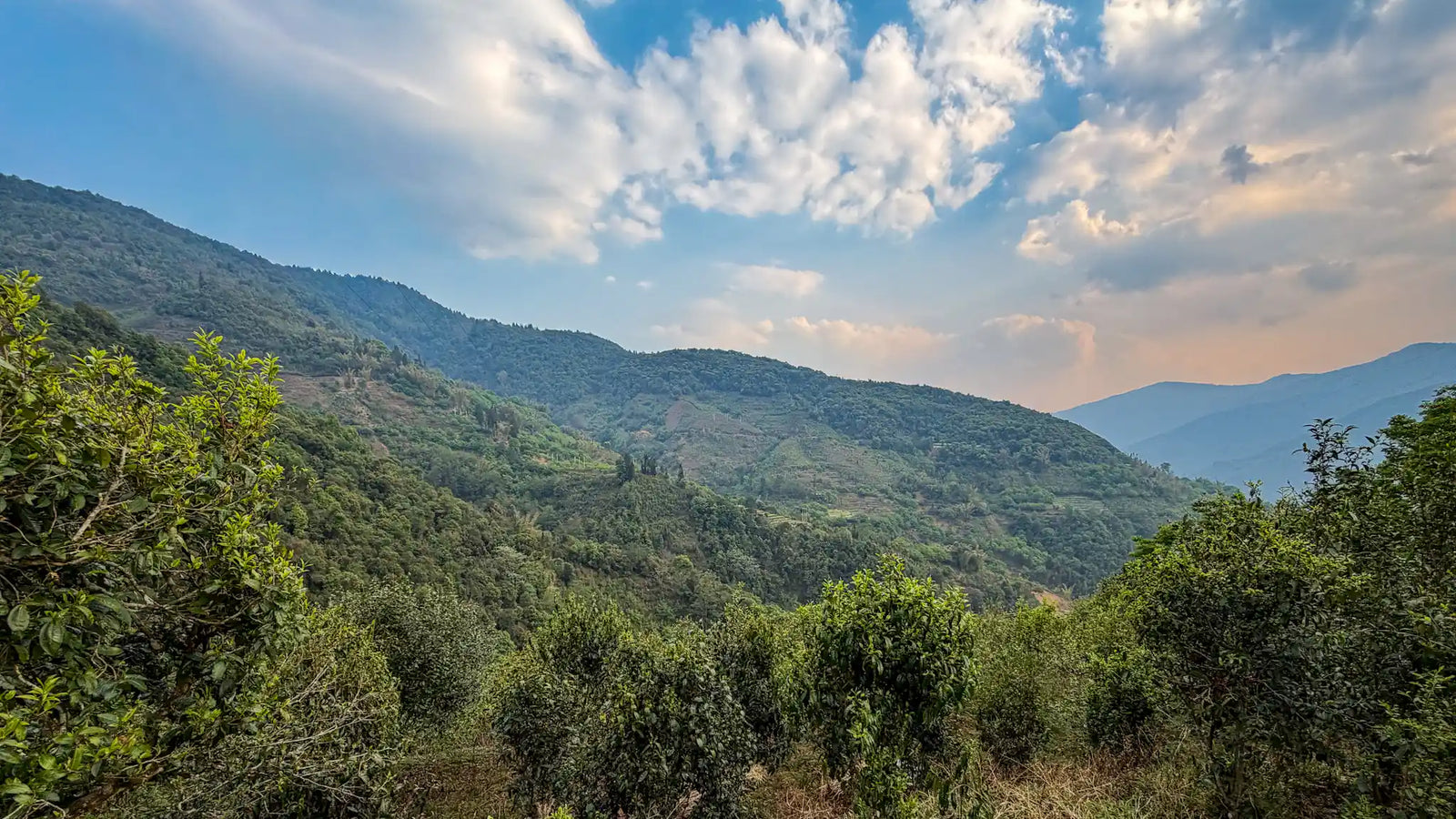
Pu'er is often spoken of as a single tea. It would be more accurate to say teas. A Pu'er from Bingdao and a Pu'er from Yiwu, even if picked on the same day, have almost nothing in common in the cup. What makes the difference is the terroir—the mountain, the altitude, the soil, the climate, the age of the trees. We spend most of the year in these mountains of Yunnan, and it is this geography that we invite you to explore here.

What is terroir for Pu'er?
The word comes from wine, but it applies to tea with the same accuracy. Terroir is the sum of natural conditions that shape a leaf even before it is picked: the altitude at which the tree grows, the soil composition beneath its roots, annual rainfall, temperature range between day and night, the presence or absence of a forest canopy, and the age of the tree itself.
In the world of Pu'er, terroir is not a connoisseur's detail—it's what defines the tea. Chinese connoisseurs don't buy "a Pu'er"; they buy a Bingdao, a Yiwu, a Lao Banzhang. The name of the mountain is the first piece of information, before the year, before the producer, before the price. And for good reason: two leaves from the same cultivar, processed in the same way, will yield fundamentally different cups if one grows at 1,200 meters in a plantation and the other at 1,800 meters in an ancient forest.
Yunnan is home to three major Pu'er producing regions, each with its mountains, villages, and trees. By discovering them, you will understand why a tea from Mengku does not have the same character as a tea from Xishuangbanna, and why this diversity makes Pu'er so rich.
Lincang: Power and Depth
It is in this region, in northwest Yunnan, that we work. Lincang is a territory of high, steep mountains, deep valleys, and ancient forests. It is also the region with the largest number of century-old tea trees in Yunnan—trees that grow at altitudes between 1,400 and 2,300 meters, often in forests, without pruning or human intervention.
The general profile of Lincang teas is one of contained strength. The liquors are dense, the aromas deep, and the tannic structure is more pronounced than in Xishuangbanna. But this power is accompanied by a crystalline sweetness at the finish—the famous huigan, that sweet return that slowly rises after each sip—which is the signature of great Pu'er from this region.

Mengku: The Heart of Lincang
Mengku is a township in Shuangjiang district, Lincang. It is one of the most famous names in Pu'er today, and for a specific reason: it is here that the Mengku Da Ye Zhong cultivar, the "Mengku big leaf," grows—a local variety that produces large, thick leaves, exceptionally rich in aromatic compounds. The soils are deep, saturated with minerals, and the subtropical mountain climate with generous rainfall and frequent mists slows growth, concentrating flavors in the leaf.
It is in Mengku that the five villages of Bingdao are located, which are perhaps the most sought-after addresses in the entire Pu'er world.
Bingdao: The Crystalline Sweetness
The name means "Ice Island" – not because of the cold, but because of the sensation the tea leaves in the mouth. The Chinese call this bingtang yun, the "rock sugar resonance": a pure, clear, fresh sweetness that lingers after the sip and doesn't fade. This sensation is what makes Bingdao famous, and it is what makes this terroir so difficult to imitate.
The village of Bingdao is perched between 1,600 and 2,000 meters above sea level, in Mengku. Its ancient trees—some are three, four, five hundred years old—grow on steep slopes, in the middle of the forest, in mineral-rich soils. The climate is that of a subtropical mountain: an average annual temperature of about 18 °C, abundant rainfall, frequent fogs, and above all, a marked thermal amplitude between day and night. It is this amplitude that gives the tea its aromatic complexity: cool nights slow growth, and the tree concentrates in each bud what it has drawn during the day.
We have been working with families in Bingdao for years. Our Pu'er Cru Bingdao Gushu and our Gushu FuTuo Bingdao come from these ancient trees and carry within them this crystalline sweetness that cannot be manufactured.

DaXueShan: The Great Snow Mountain
DaXueShan literally means "Great Snow Mountain". It is a forest massif that culminates between 1,900 and 2,600 meters above sea level, covered with dense primary forest where tea trees have grown wild for centuries—perhaps millennia. In 1997, botanists discovered in the upper part of DaXueShan, in Mengku, a group of wild tea trees spread over approximately 500 hectares. Among them, a specimen estimated to be over 2,700 years old—one of the oldest living tea trees ever identified.
DaXueShan tea has a character that connoisseurs describe as "wild". The trees grow in dense forest, surrounded by azaleas, camphor trees, and a lush vegetation that nourishes the soil and perfumes the air. Their roots penetrate deep into ancient forest humus, rich in organic matter. All of this is reflected in the cup: a mineral liquor, delicate floral aromas—wild orchid, mountain flower—and a surprising length on the palate. It is a tea unlike any other, precisely because it grows in an environment where human intervention is almost non-existent.
Our Wild Antique Pu'er comes from these forests—a tea from century-old DaXueShan trees, picked in spring, sun-dried, with no other intervention than human hands and time.

Xishuangbanna: The Historical Cradle
If Lincang is strength, Xishuangbanna is elegance. It is in this prefecture of southern Yunnan, bordering Laos and Burma, that Pu'er wrote its history. It is here that the six ancient tea mountains—the Liu Da Cha Shan—are located, which supplied the Chinese imperial court since at least the 18th century.
These six mountains—Yiwu, Gedeng, Mansa, Mangzhi, Yibang, and Youle—bear names that resonate in the tea world like appellations in Burgundy. In 1744, during the reign of Emperor Qianlong, the imperial court officially designated them as tribute mountains: the tea sent to Beijing came from these forests. This was the birth of Pu'er as the world knows it.
The profile of Xishuangbanna teas leans towards finesse rather than power. Yiwu, the most famous of the six, produces raw Pu'er whose natural sweetness, roundness, and aromatic complexity—honey, flower, sweet undergrowth—make them classics for aging. Teas from Yibang are lighter, more floral. Those from Youle are more structured. Each mountain has its own distinct voice, and it is this polyphony that has made Xishuangbanna's reputation.
Xishuangbanna is also home to the "six new mountains," west of the Lancang River: Nannuo, Bulang, Hekai, Bada, Mengsong, and Jingmai. The village of Lao Banzhang, in Bulang mountain, produces one of the most highly rated Pu'er in the world—a powerful tea, bitter on the first sip, with a rare and extensive sweet aftertaste. Further south, Jingmai Mountain, inscribed in 2023 on the UNESCO World Heritage list, is a landscape of ancient tea trees cultivated in forests for nearly a thousand years.

The Pu'er Region: Where It All Began
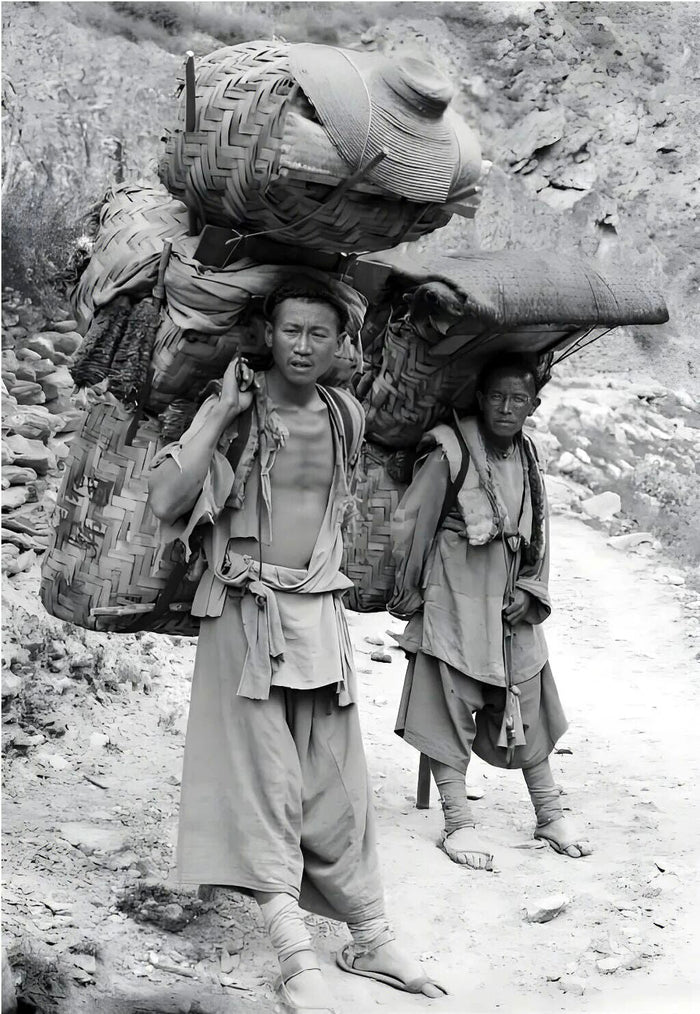
It is from this city, formerly called Simao, that the tea takes its name. Pu'er was the great trading post where caravans gathered before taking the Tea Horse Road to Tibet, Mongolia, and beyond. The tea that passed through this city took its name, regardless of its mountain of origin, and that is how "Pu'er" became the generic name for all post-fermented teas from Yunnan.
Even today, the Pu'er prefecture is an important production territory. The mountains of Jingdong, Jinggu, and Zhenyuan produce teas with a profile intermediate between the power of Lincang and the elegance of Xishuangbanna—teas often less famous, but sometimes of remarkable quality, and at more accessible prices than the most sought-after locations.
What Makes a Great Terroir
We can summarize what distinguishes an exceptional terroir in five factors, which combine differently depending on the mountains.
Altitude. The best Pu'er grows between 1,400 and 2,300 meters. The higher the altitude, the more pronounced the day-night temperature difference, the slower the growth, and the more aromatic compounds concentrate in the leaf. It's a simple principle: a slow-growing tree yields a denser tea.
Soil. Volcanic soils, forest soils rich in humus, soils containing white sandstone (characteristic of Menghai)—each brings its own minerality. A Pu'er from forest soil does not have the same foundation as a Pu'er from clay soil.
Age of trees. A twenty-year-old plantation tea bush and a century-old tree rooted in the forest do not draw on the same resources. The deep roots of ancient trees descend into soil layers inaccessible to plantation bushes, bringing a mineral complexity that translates directly into the cup.
Forest environment. A tea tree that grows in a forest, surrounded by other species—camphor trees, azaleas, bamboo—benefits from a biodiversity that enriches the soil and protects the tree without any inputs. This is the most natural agriculture there is, and it is the one that produces the most unique teas.
Climate. The combination of generous rainfall, frequent fogs, warm days, and cool nights creates a slight and constant stress that encourages the tree to concentrate its defenses and aromas in each new leaf.

Why We Chose Mengku
We are sometimes asked why we work in Lincang rather than Xishuangbanna, which is the historical cradle of Pu'er. The answer is simple: it is where we met the people we wanted to work with, and it is where we found the trees that spoke to us.
Mengku concentrates the largest number of ancient trees in Yunnan. Its DaXueShan forests are home to some of the oldest wild tea trees in the world. Its villages, with Bingdao at the forefront, produce teas of a purity and depth that exist nowhere else. And above all, the families with whom we have worked for years share our high standards: manual harvesting, sun drying, rigorous selection of buds, no chemical inputs.
A terroir is only as good as the people who cultivate it. The mountain provides the raw material; it is human expertise—the hand of the picker, the eye of the producer, the patience of the one who dries the leaves in the sun—that transforms this material into tea. And it is this encounter between a place and people that we bring to you in every cup.
Frequently Asked Questions
What is the best terroir for Pu'er?
There is no "best" terroir—each mountain has its own signature. Bingdao is famous for its crystalline sweetness, Yiwu for its elegance and aging potential, Lao Banzhang for its power and noble bitterness. The best terroir is the one that suits your palate. The only way to decide is to taste.
Why are Bingdao Pu'er teas so expensive?
Bingdao combines several factors that drive prices up: ancient trees in limited numbers, low annual production (a few tons per year for genuine Bingdao), very strong demand in the Chinese market, and a unique taste profile—the famous "crystalline sweetness" that exists nowhere else. As supply is much lower than demand, prices reflect this genuine rarity.
How do you know if a Pu'er truly comes from the indicated terroir?
Traceability is the key. A serious producer knows their trees, their plots, and their pickers. At Daothé, we work directly with families in Mengku and Bingdao, and we know every tree from which our tea comes. Beware of prices that are too low for a renowned terroir: a "Bingdao" sold at the price of a plantation tea is almost certainly a blend that only has the name Bingdao.