In the world of Pu'er, one word comes up more than any other: gushu. We see it on packaging, in descriptions, on tea stalls in China. It means "ancient tree" and it changes everything. A gushu Pu'er is not like a plantation Pu'er, neither in taste, nor in depth, nor in its endurance to infusion. Here's why.

What gushu means
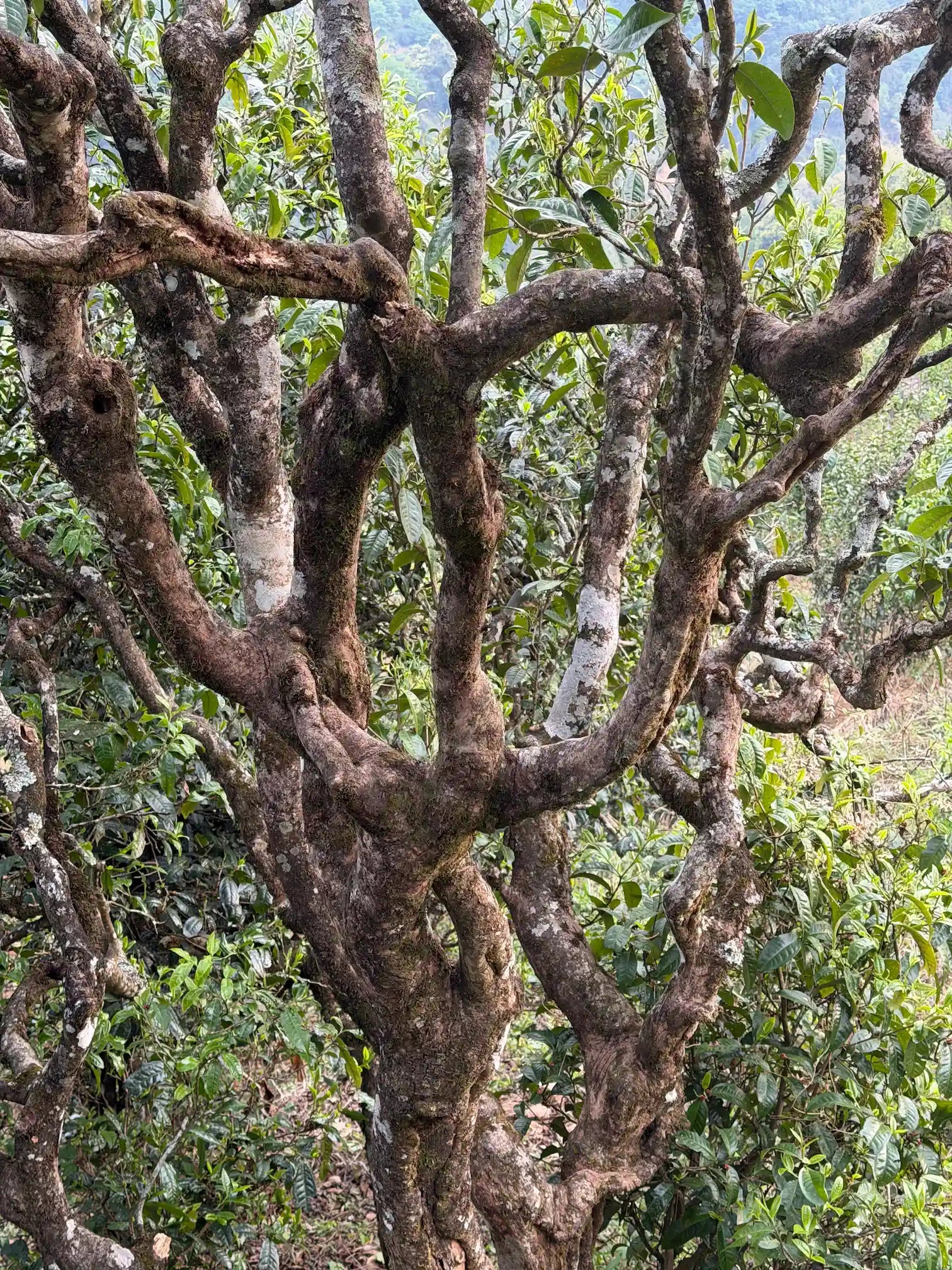
The word is Chinese: gu (古) means ancient, shu (树) means tree. A gushu is therefore an ancient tree, in this case a tea tree that has grown freely, without pruning or intervention, for at least a century. Some are two hundred years old, others five hundred, others much more. In the DaXueShan forest, in Mengku, some specimens have been estimated to be more than two thousand seven hundred years old by Chinese botanists. In 2023, the cultural landscapes of the ancient tea forests of Jingmai, in southern Yunnan, were inscribed on the UNESCO World Heritage List, a recognition of the exceptional value of these ancient tea forest ecosystems.
There is no universal official definition of the minimum age. Depending on the sources and markets, gushu is referred to for trees from one hundred to three hundred years old; and unfortunately, "gushu" is often heard on stalls where the tea trees are actually very young. This vagueness is both a richness and a source of confusion – we will come back to this. What is certain is that the term refers to a tree of a different order than plantation tea trees: a tree that has had time to root deeply, to adapt to its soil, to develop a complexity that young bushes do not achieve.
The tree and the bush: two worlds
To understand the difference, you have to start from the bottom – under the ground. A plantation tea tree, called taidi cha (台地茶, "terrace tea") in Chinese, is a low bush, regularly pruned, planted in tight rows, often propagated by cuttings. Its root system is shallow: a network of fibrous roots that spreads on the surface. This is efficient for absorbing applied fertilizers, but it means that the bush only draws from the superficial layer of the soil.
A gushu is the opposite. Grown from seed – not cuttings – it develops a main taproot that delves deep into the subsoil, sometimes down to the bedrock. This root seeks out minerals and trace elements that plantation bushes simply cannot access. Over time, the tree also extends a considerable lateral root network, which forms connections with the surrounding flora – mycorrhizal fungi, forest humus, companion species. All of this is reflected in the leaf, and then in the cup.

TWO TYPES OF TEA TREES
Taidi cha: plantation
Low bush, pruned, in rows
From cuttings (clone)
Shallow roots
High yield
Simple and light aromatic profile
Gushu: ancient tree
Large, free-growing tree, in the forest
From seed (sexual reproduction)
Deep taproot
Low yield
Rich, mineral, complex profile
What you taste in a gushu
The difference between a plantation tea and an ancient tree tea is not just in books – it's in the taste. And often, the first sip is enough to tell them apart.
A plantation Pu'er tends towards lightness and simplicity. The aromas are fresh, floral, pleasant but without great depth. The liquor is thin, sometimes a little flat, and the flavor fades quickly after the sip. A good plantation tea is an honest tea, but it doesn't hold attention for long.
A gushu is something else entirely. The liquor is thick, almost oily in the mouth – the Chinese call it cha you, "tea oil." The aromas are deeper and more complex: honey, soft leather, ripe fruit, undergrowth, aged wood, sometimes a floral hint that appears on the third or fourth steeping. But what truly distinguishes a gushu is what happens after the sip: a full and lasting sweet aftertaste (huigan), a freshness that slowly rises in the throat, and a physical presence in the mouth – what Chinese enthusiasts call cha qi, the energy of the tea, which settles and lingers.
There is also the question of endurance. A plantation tea yields three, four, perhaps five infusions before fading. A good gushu can withstand fifteen to twenty, each steeping revealing a new facet. It is this endurance to infusion that is the most reliable signature of the ancient tree: the leaf of an old tree contains more pectin, free amino acids, and total soluble extracts, which gives it a chemical depth that successive infusions reveal layer by layer.

Why gushu are rare
Ancient trees are not manufactured. You cannot decide to plant them: it takes a century for a tea tree to become a gushu, and several centuries for it to reach full maturity. This incompressible time is the primary reason for their rarity.
The second reason is geographical. Gushu grow in forests, on steep slopes, often at altitudes that make access difficult. They are not harvested by machine – this is physically impossible on such terrain. Harvesting is done by hand, sometimes by climbing the tree, and the yield per tree is low. A large gushu can yield a few kilograms of fresh leaves per harvest, compared to tens of kilograms for an equivalent plantation area.
The third reason is economic. The fame of gushu has driven up prices over the last twenty years, which has created a market for counterfeits. Plantation teas sold as gushu, leaves from young trees mixed with a few old leaves, fanciful labels on cakes without provenance – the phenomenon is massive, especially outside China. This is why direct relationships with producers are essential: without knowing the trees, the families who cultivate them, and the plots from which the leaves come, it is almost impossible to guarantee the authenticity of a gushu.
Age categories
In China, tea professionals use an informal but widely shared classification based on the age of the trees. It has no legal value, but it structures the market and helps understand what you are buying.
| Category | Age | Characteristics |
|---|---|---|
| Xiao shu (小树) | 0–50 years | Young trees or plantation bushes, simple and light aromas |
| Zhong shu (中树) | 50–100 years | Established trees, developing complexity, deeper roots |
| Da shu (大树) | 100–300 years | Large trees, marked aromatic depth |
| Gushu (古树) | 300+ years | Ancient trees, exceptional complexity and infusion endurance |
In practice, the term gushu is often used broadly to refer to any tree over a hundred years old – which is not wrong in itself (a hundred years is already ancient), but can be misleading when comparing a hundred-and-twenty-year-old tree to a five-hundred-year-old patriarch. The difference in the cup exists, even if it is more subtle than between a plantation tree and a centenarian.
A living heritage
Gushu are not just tea trees – they are living beings that have spanned centuries. Some have witnessed the caravans of the Tea and Horse Caravan Road. Others were already there when the first families settled in the Mengku mountains. Their presence in the forest is no accident: it is the result of a long cohabitation between humans and trees, where one harvests without depleting, where one lets the tree rest between harvests, where one never prunes. Our article on the making of Pu'er details this savoir-faire, from the bud picked to the finished cake.
This relationship with time is perhaps what makes gushu so special. A five-hundred-year-old tree does not produce a "better" tea in the simple sense of the word – it produces a tea that carries five hundred years of soil, rain, sun, and patience within it. It is a form of plant memory, inscribed in each leaf, released in each infusion. And it is this memory that one tastes when one takes the time to properly prepare a gushu – slowly, steeping after steeping, without rushing.

Our gushu
We have been working with ancient trees since the beginning of Daothé. It was a natural choice: when you live six months a year in the Yunnan mountains, when you know the families, when you see the trees, when you follow the harvests year after year, you quickly understand that the difference between a plantation tea and a gushu tea is not a matter of marketing – it is a reality that can be tasted in every cup, also with a spiritual and energetic aspect to consider.
Our Antique Wild Pu'er Raw comes from the hundred-year-old trees of DaXueShan, the Great Snowy Mountain. Our Gushu FuTuo Bingdao and our Bingdao Gushu Pu'er Raw come from the old trees of Bingdao village, in Mengku. For all our teas, we know the trees, the plots, the families who harvest. It is this traceability, as much as the age of the trees, that makes the value of a true gushu.
Frequently asked questions
What exactly is a gushu?
The term gushu (古树) means "ancient tree". In the world of Pu'er, it refers to a tea tree over three hundred years old, rooted in the forest, unpruned, and hand-picked. These trees draw their resources deep from the forest soil and produce leaves with an aromatic complexity and infusion endurance that plantation trees cannot match.
Is a gushu Pu'er always better than a plantation Pu'er?
Not automatically. A well-made gushu surpasses a plantation tea in depth, mouthfeel length, and endurance over successive infusions. But a gushu that is poorly harvested or poorly processed can be disappointing. The quality of the craftsmanship – harvesting, pan-firing, sun-drying – counts as much as the age of the tree.
How to recognize a real gushu?
In the cup, a gushu is distinguished by its endurance: it yields ten to fifteen infusions without weakening, with a clear aromatic progression from one steeping to the next. The infused leaves are large, whole, supple, and a deep green. But the true guarantee remains traceability – knowing the producer, the mountain, the plot. The market is full of fake gushu; trust in the source is the first filter.