"Is Pu'er (or pu'erh) exciting?" The question comes up with every tasting, and the answer deserves more than a simple yes or no. Here's what truly changes from one cup to another, and why our Pu'er teas don't have the same intensity as industrial Pu'er teas.

Theine and caffeine: the same molecule, very different effects
Let's start by clearing up a long-standing confusion. Theine and caffeine are the same molecule. Strictly, chemically, biologically the same. The word "theine" was invented in the 19th century, at a time when chemists thought they had isolated two different substances in coffee and tea. It has since been confirmed that it is the same alkaloid, 1,3,7-trimethylxanthine. The word "theine" has remained in common use and in tea marketing communication, but it does not denote anything chemically distinct.
Tea does contain caffeine, but that doesn't mean drinking tea and drinking coffee have the same effect. The perceived effect depends on the quantity, the absorption rate, the other compounds that accompany the alkaloid in the drink, and the preparation. It is this context that explains why our Pu'er, and particularly our fermented Pu'er, do not behave in the body like coffee, nor like a classic green tea.
More precisely, four factors determine the caffeine content and the perceived effect of a cup of Pu'er. Here they are, and this is where our Pu'er teas distinguish themselves from industrial Pu'er teas on the market.
First factor: fermentation
Fermentation profoundly transforms the leaf, and caffeine is no exception. Under the action of microorganisms, a significant portion of the caffeine is degraded, and the leaf material produces compounds that slow down the absorption of what remains. The longer the fermentation and the more carefully it is conducted, as it is more difficult to master, the deeper this transformation and evolution of the tea.
This is where the clearest difference lies between our fermented Pu'er and those you will find elsewhere. Standard industrial wo dui lasts 15 to 40 days, on piles of several tons of cheap tea. The fermentation is fast, brutal, predictable. Our method is the opposite: we ferment in small batches, using noble material (gushu), for 90 to 100 days depending on the weather. More than double the standard time.
This choice is not a technical detail. This long and gentle fermentation completes the transformation that rapid wo dui (fermentation) prematurely interrupts. The theine in the leaf is greatly reduced, the stimulating effect almost entirely fades, and what remains in the cup is a calm, grounded presence that accompanies without agitating. All our Pu'er Shi (fermented) are from this long artisanal wo dui. For example, our Organic Gong Ting Pu'er buds and our 20-year XianLingZhi Bingdao.
Second factor: the age of the tea trees
The tea plant accumulates more caffeine in its young shoots than in its mature leaves. This is a defense strategy: caffeine serves to ward off insects from the tenderest parts of the plant. On a bush cultivated in a plantation, pruned low and exploited to the maximum to produce buds, the caffeine content can reach high levels.
Ancient tea trees work differently. A tree several hundred years old, which grows without being pruned, whose roots plunge deep into the bedrock, whose leaves are harvested by hand with moderation, has a very different chemical profile. Less caffeine in concentration, more amino acids (especially L-theanine, which we discuss below), more minerals drawn from deep within, more pectins that give the tea its round body and silky feel. The ratio is generally more balanced.
At Daothé, we work exclusively with ancient tea trees, mainly in Bingdao and the Mengku region. For us, a true ancient tree (gushu) starts at 300 years and older. This is one of the reasons why our Antique Wild Raw Pu'er, although it is a sheng (therefore not wo dui fermented), is drunk more gently than a plantation sheng. And our Raw Bingdao Gushu Pu'er cake takes this logic to its extreme: the Bingdao gushu cake offers immediate sweetness from the first infusion, whereas most young sheng teas are bitter and tonic.

Third factor: leaf grade
On a single tea plant, caffeine is not distributed uniformly. Young buds contain more, while more mature leaves contain less. The grade of a Pu'er, meaning the type of leaves used, therefore directly influences the stimulation profile.
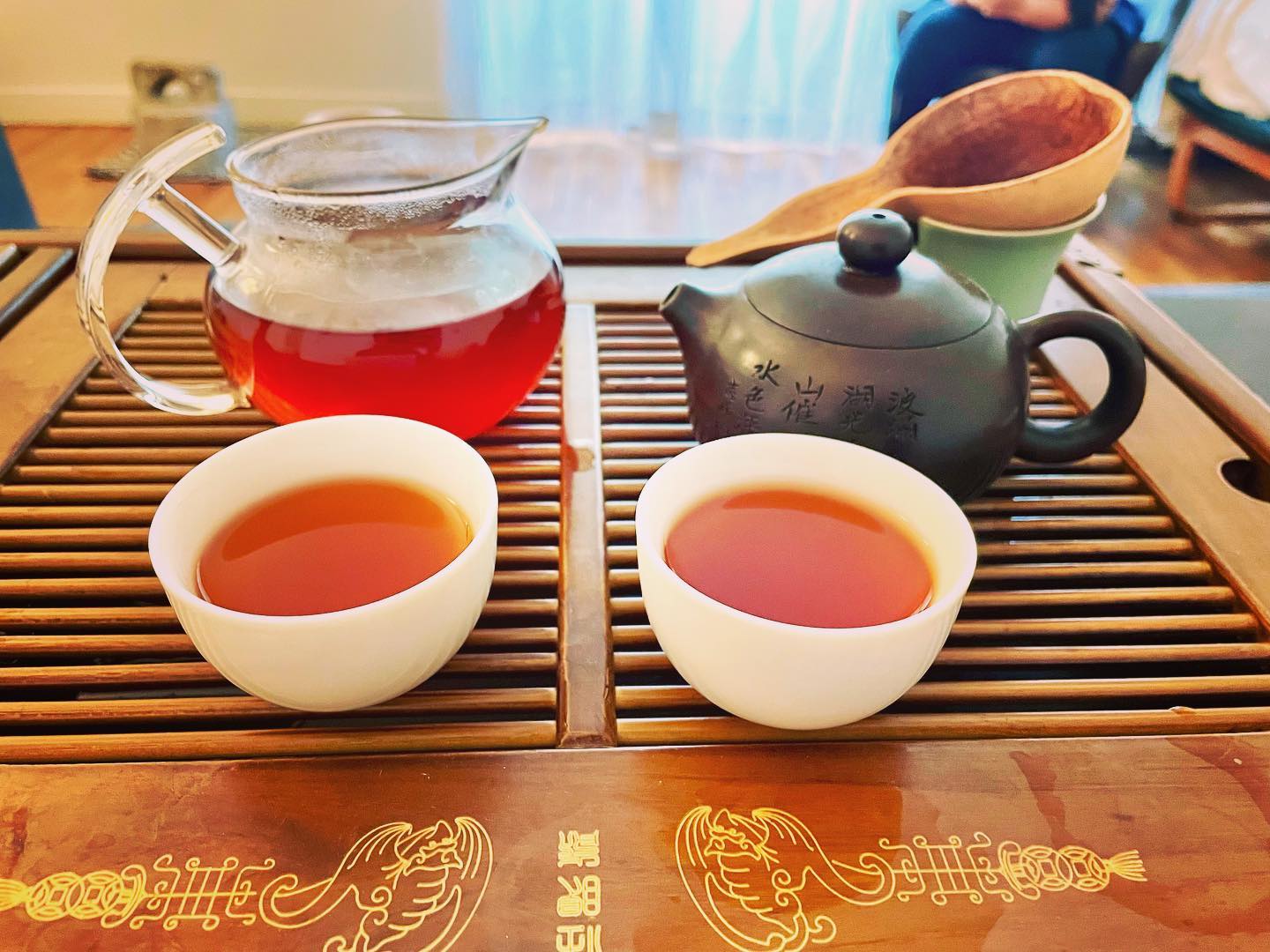
The Gong Ting (宫廷, "imperial") grade we use for our fermented Pu'er is composed exclusively of very fine golden buds. This might suggest a high caffeine concentration, but this is where the long fermentation takes over: our 90 to 100 days of wo dui profoundly transform these buds, and the result in the cup is a soft and settled mahogany liquor. The imperial grade provides the nobility of the leaf, while the long fermentation gives a gentle feeling.
Our Pu'er Gushu FuTuo Gong Ting Bingdao, in a convenient nugget format, is a good example of this logic: noble material (Gong Ting from Bingdao gushu), controlled fermentation, individual format. For those who want a practical dose without sacrificing quality.
Fourth factor: brewing techniques
With the same material, your brewing method changes the amount of caffeine that ends up in your cup. Three levers are at your disposal.
Temperature first. Hotter water (around 95 degrees) extracts more compounds than lukewarm water. It's a compromise: Pu'er needs simmering water to reveal its aromas, so we don't lower the temperature too much. But we can compensate with other parameters.
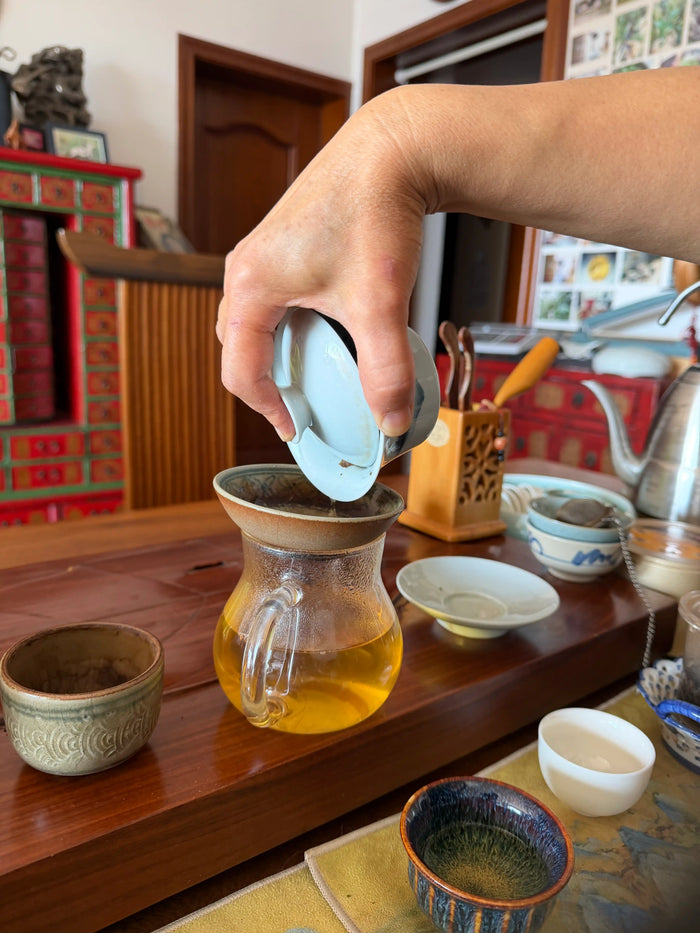
Duration next. Caffeine is released quickly, within the first two minutes. A long infusion (5 minutes) extracts most of the caffeine present in the leaf. A succession of short infusions (10 to 20 seconds in Gong Fu Cha) spreads this release over several cups, which reduces the perceived dose per cup and allows the body to absorb caffeine gradually. This is one of the great advantages of the Gong Fu Cha method for those sensitive to caffeine.
Finally, the dose. More leaves in the same water, more caffeine released. Our complete guide to preparing Pu'er details each method and recommended dosages. To moderate caffeine, you can also rinse the leaves twice before the first consumed infusion, which removes an additional fraction of the alkaloid. We always recommend not rinsing our Pu'er; they are produced cleanly, with no leaves on the ground, and fermented in a healthy way. The first infusions are often the best, and it would be a shame to waste such a tea.
Why our Pu'er teas are so grounding
To these four factors, a fifth element must be added, common to all teas but particularly present in ours. Tea contains L-theanine, an amino acid that no other food provides in significant quantities. L-theanine has been the subject of numerous studies, which describe a calming effect on the nervous system and improved concentration without agitation. Combined with caffeine, it profoundly changes the stimulation profile: fewer jolts, longer duration, less nervousness.
Ancient tea trees, which grow slowly and accumulate more amino acids, produce leaves richer in L-theanine than plantation bushes. The L-theanine to caffeine ratio is more favorable, which explains the feeling of grounding that our teas provide, whereas coffee or industrial green tea give a more abrupt boost.
Combine this with our 90 to 100-day wo dui (fermentation) for fermented Pu'er, and you get what many of our customers describe as a calm presence in the cup. Pu'er settles you down. It doesn't wake you up, it accompanies you. Several enthusiasts write to us that they have made Organic Gong Ting Pu'er their evening ritual, without it disturbing their sleep, quite the opposite.
Tradition
Our Pu'er teas contain less perceived caffeine than industrial green tea or coffee, and other Pu'er teas, due to the choice of raw material (gushu), the fermentation process (artisanal and long for shou), the leaf grade, and the care taken at each step. Chinese enthusiasts have been drinking this type of Pu'er daily, at all times of the day, for over a thousand years.
Which Daothé Pu'er for which moment
Here's how our Pu'er teas are distributed according to the time of day, based on their caffeine content and perceived effect, following a logic similar to that of Pu'er through the seasons.

For morning and mid-morning, our Antique Wild Raw Pu'er from Yunnan is a tonic yet gentle sheng that awakens with subtlety. The ancient and wild tea trees from which it comes give it a settled vibrancy, without agitation.
For afternoon and daytime, our Organic Gong Ting fermented Pu'er buds are versatile. Fermented for 90 to 100 days, soft enough not to be heavy, present enough to accompany. This is the everyday Pu'er, the one we drink at home.
For late afternoon and evening, our 20-year XianLingZhi Bingdao adds twenty years of maturation to the long fermentation. The perceived theine is even more discreet, the profile deep and settled. A Pu'er that can be drunk after dinner without any fear for sleep.
For enthusiasts who want a practical and portable dose, our Pu'er Gushu FuTuo Gong Ting Bingdao in individual nuggets offers the same gentle profile, in a convenient take-along format.
All our Pu'er teas are handmade. Our fermentation is done in small batches, using material from ancient trees, with an artisanal wo dui of 90 to 100 days. This is our signature, and it changes the nature of the cup.
Frequently asked questions
Are theine and caffeine different?
No, they are exactly the same molecule, 1,3,7-trimethylxanthine. The word "theine" dates back to the 19th century, when it was thought that tea and coffee contained different stimulants. Science has since confirmed that it is the same alkaloid. The word "theine" has remained in common usage, but it does not denote anything chemically distinct.
Why do your fermented Pu'er teas contain less theine than others?
Because our artisanal fermentation lasts 90 to 100 days, compared to 15 to 40 days for standard industrial wo dui. This long and gentle fermentation, conducted in small batches of noble material (Bingdao gushu), profoundly transforms caffeine and releases compounds that slow its absorption. The result is a cup with a settled presence, where the stimulating effect is greatly attenuated.
Does Pu'er from ancient trees contain less caffeine?
Yes, generally. Ancient tea trees, which grow slowly and whose roots plunge deep into the soil, have a different chemical profile than plantation bushes. The caffeine concentration is generally lower, and the L-theanine to caffeine ratio is more favorable, which translates into a more balanced, settled, and less peaky effect in the cup.
Which Daothé Pu'er for the evening, without disturbing sleep?
Our Organic Gong Ting Pu'er is our recommendation for the evening and after-dinner. Thanks to its long traditional fermentation, the result is a deep and calm Pu'er that many of our customers drink in the evening without any impact on their sleep, quite the opposite. Our 20-year-old XianLingZhi Bingdao also works very well for this purpose with twenty additional years of maturation.
How to brew Pu'er to moderate caffeine?
Three levers. Prioritize the Gong Fu Cha method (short infusions of ten to twenty seconds, repeated), which spreads the release of caffeine over several cups instead of concentrating it in a single one. For most Pu'er, perform a first five-second rinse that is discarded, but not for ours. This eliminates a fraction of the alkaloid. Do not overdose: four to five grams per liter are sufficient.
To discover the calm profile of our artisanal Pu'er, start with our Organic Gong Ting Pu'er Buds, the versatile shou we drink at home, fermented for 90 to 100 days.
To learn more about what makes our fermentation different, read our article on Pu'er and probiotics.