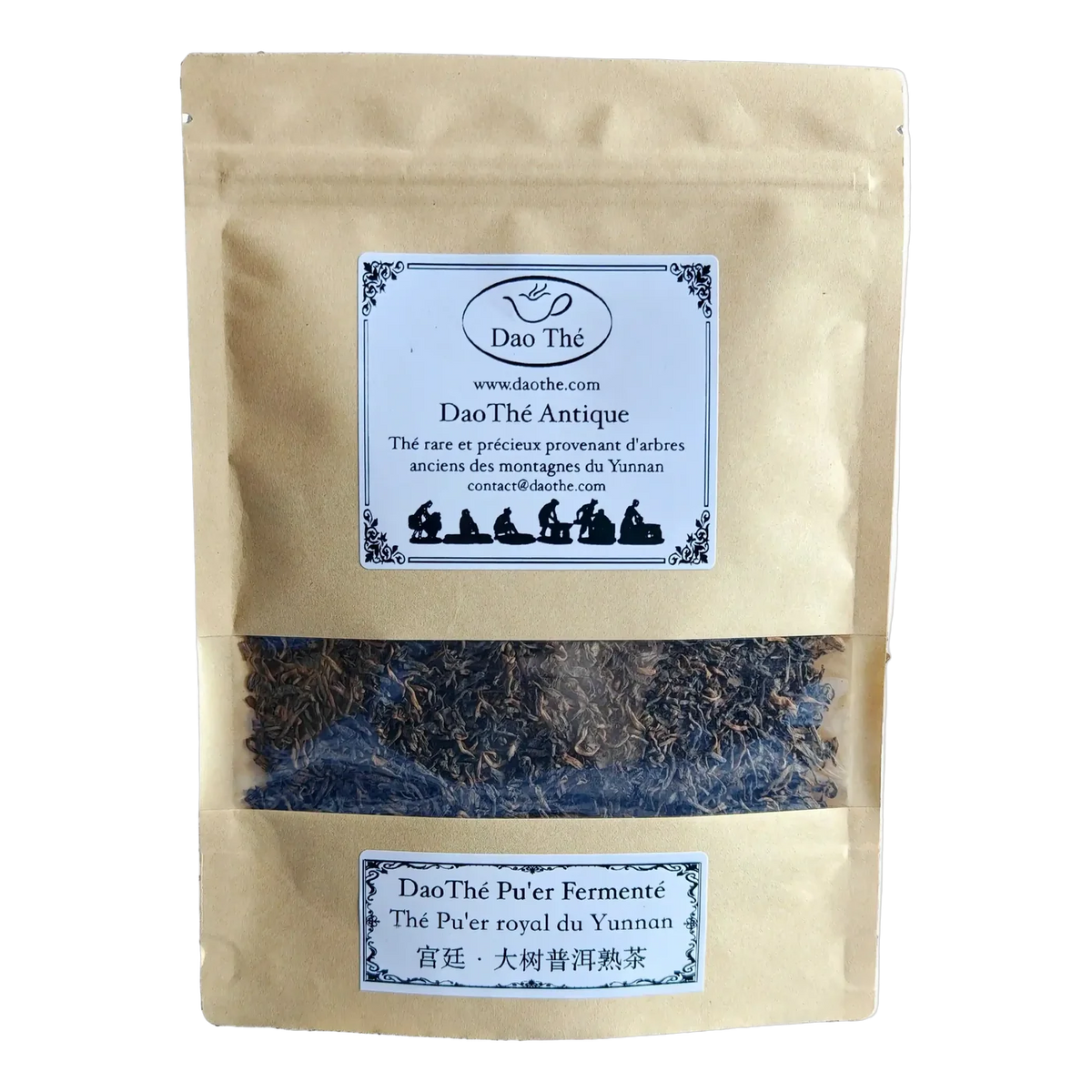
Daothé GongTing Fermented Pu'er
✦ Naturally low in caffeine, enjoyed from morning to night
€15 / 50 g, i.e. €30 / 100 g.
Golden buds from Yunnan, slow fermentation, naturally very low in caffeine.
Our GongTing-grade fermented Pu'er is a tea you can drink all day long: slow fermentation has consumed almost all of its caffeine. It is a dark, round, gentle tea, selected from the finest buds in the post-fermentation sorting. We bring it back from DaXueShan, in Yunnan.
A mahogany liquor, silky texture, notes of damp earth, undergrowth, prunes and sandalwood. A natural sweetness, without bitterness, approachable from the very first cup.
Why this tea
Naturally very low in caffeine. The prolonged fermentation of Pu'er shu naturally breaks down most of the alkaloids contained in the fresh leaf. What remains is residual. This is a tea you can drink in the evening, after dinner, without the risk of being kept awake. For those sensitive to caffeine, it is one of the rare teas that opens the whole day to them.
The GongTing grade, the finest part of the harvest. In fermented Pu'er, GongTing (贡廷, literally “imperial”) refers to the finest sorting carried out after fermentation. Only the intact buds and young leaves are kept, recognisable by their golden colour and velvety surface. An ordinary fermented Pu'er mixes sizes and maturities; GongTing keeps only the best of each batch. The liquor comes out gentler, rounder, with a length on the palate that ordinary grades do not reach.
Virtues in Chinese medicine. In traditional Chinese medicine, fermented Pu'er is associated with digestion and inner warmth. It traditionally accompanies meals in southern China and is gladly drunk after a well-laden table. It is also the tea served to guests during Cantonese yum cha. A clear cup at the end of the meal, like a return to calm.
Origin and terroir, DaXueShan
Pu'er grows only in Yunnan, in the far south-west of China. It is here that one finds Camellia sinensis var. assamica, a large-leaf variety particular to this region, which thrives on red, clay-rich soil, in the misty forests between 1,200 and 2,800 metres of altitude. This combination gives the leaves their density, their richness in enzymes and polyphenols, and their propensity to ferment.
The leaves of our GongTing come from DaXueShan, the “Great Snowy Mountain”, one of the most prized terroirs of Yunnan for its ancient and wild tree teas. The forest stretches high in altitude, in a coolness and humidity that impose slow growth on the tea trees: it is this slowness that concentrates the aromas. The buds are harvested by hand in spring, then sorted one by one before entering fermentation.
Preparation
Fermented Pu'er enjoys boiling water: 95 to 100 °C, which draws out its sweetness without the risk of bitterness. A low-mineral or spring water is better than hard water, which crushes the fine aromas of the GongTing grade. The leaves re-infuse four to six times in the classic method, more in gongfu.
With a gaiwan, to explore each infusion. Five to seven grams in a 100 to 150 ml gaiwan. Boiling water, no rinsing. First infusion twenty to forty seconds, lengthening slightly with each round. The silky texture of GongTing appears from the second infusion and holds remarkably long.
With a tea ball, for the day. Three grams in a ball, one litre of boiling water, two to four minutes. The ball can be reused a second time by lengthening the time slightly.
In a teapot, preferably Yixing clay. The porosity of Yixing absorbs the earthy and woody aromas over the infusions. Four to five grams per litre, two to three minutes to begin. A ceramic or cast-iron teapot also does well.
In a thermos, for the office. Three grams at the bottom of the thermos, boiling water. The sweetness of GongTing withstands a long infusion without turning bitter: the liquor stays stable from morning to late afternoon.
Storage and ageing
Like all Pu'er, fermented GongTing gains with time. The earthy and woody aromas refine, the sweetness deepens, the liquor fills out. It is not the transformation that a raw Pu'er undergoes, but a real evolution over several years.
Keep it in its resealed pouch, away from light and strong odours: fermented Pu'er readily absorbs what surrounds it. No refrigerator, no airtight plastic box. A ceramic, wooden or tin box, odourless, does the job perfectly.
Detailed tasting notes
A deep red-brown liquor, almost mahogany, clear. On the nose, damp earth, undergrowth, a light note of prunes and sandalwood. On the palate, the texture comes first, round, silky, without roughness. Bitterness is almost absent, replaced by a natural, lightly sugared sweetness. The finish is delicate, persistent, with a woody return and a gentle warmth. Approachable from the very first cup, even for someone who has never drunk Pu'er, yet without lacking depth, as the successive infusions reveal.
Characteristics
- Type: Fermented Pu'er (Pu'er shu / Shou Cha)
- Grade: GongTing, fine buds and top-choice leaves
- Origin: Yunnan, China, DaXueShan
- Form: whole leaves and buds, loose leaf
- Net weight: 50 g
To go further
Three reads to know this tea better and prepare it as we do.
- What is Pu'er tea? — origins, terroirs, traditional virtues.
- Fermented Pu'er or raw Pu'er — two families, two characters, how to choose.
- How to prepare Pu'er tea — gaiwan, teapot, tea ball, thermos.
Detailed characteristics
| Terroir | DaXueShan, Yunnan (ancient and wild tree teas) |
| Altitude | 1,800 to 2,000 metres |
| Type | Shou (fermented) |
| Grade | Gong Ting (imperial grade, buds) |
| Harvest | Recently pressed |
| Aromatic profile | Gentle, amber, approachable |
| Ageing potential | 10 years and more |
| Sourcing | Direct from the grower in Yunnan |
Who it's for
For those who want to discover fermented Pu'er without committing to a large quantity.
The 50-gram format is ideal for a first tasting or as a gift.
Cantonese tradition places this kind of Pu'er alongside meals.
To go further
Discover Pu'er and digestion and How to prepare Pu'er tea on our blog.

Tea pressed by hand, as it was a thousand years ago
Qiao has been making tea for thirty years. By hand, following the old ways, she presses each cake herself on a stone mill, a craft handed down for more than a thousand years and today listed as intangible cultural heritage.
Our tea trees, some several centuries old, grow above 1,800 metres: we call them the "old immortals." Their leaves are fixed by hand in great woks heated over a wood fire, then rolled. Six months a year, we are there, at every step.


