For centuries, in the tea houses of southern China, Pu'er (or pu'erh) has accompanied meals. This is not just one custom among others; it is a practice that has survived all trends. Before we look at what science is beginning to say about it, let's first listen to what tradition observes.

A Cantonese Tradition That Has Spanned Centuries
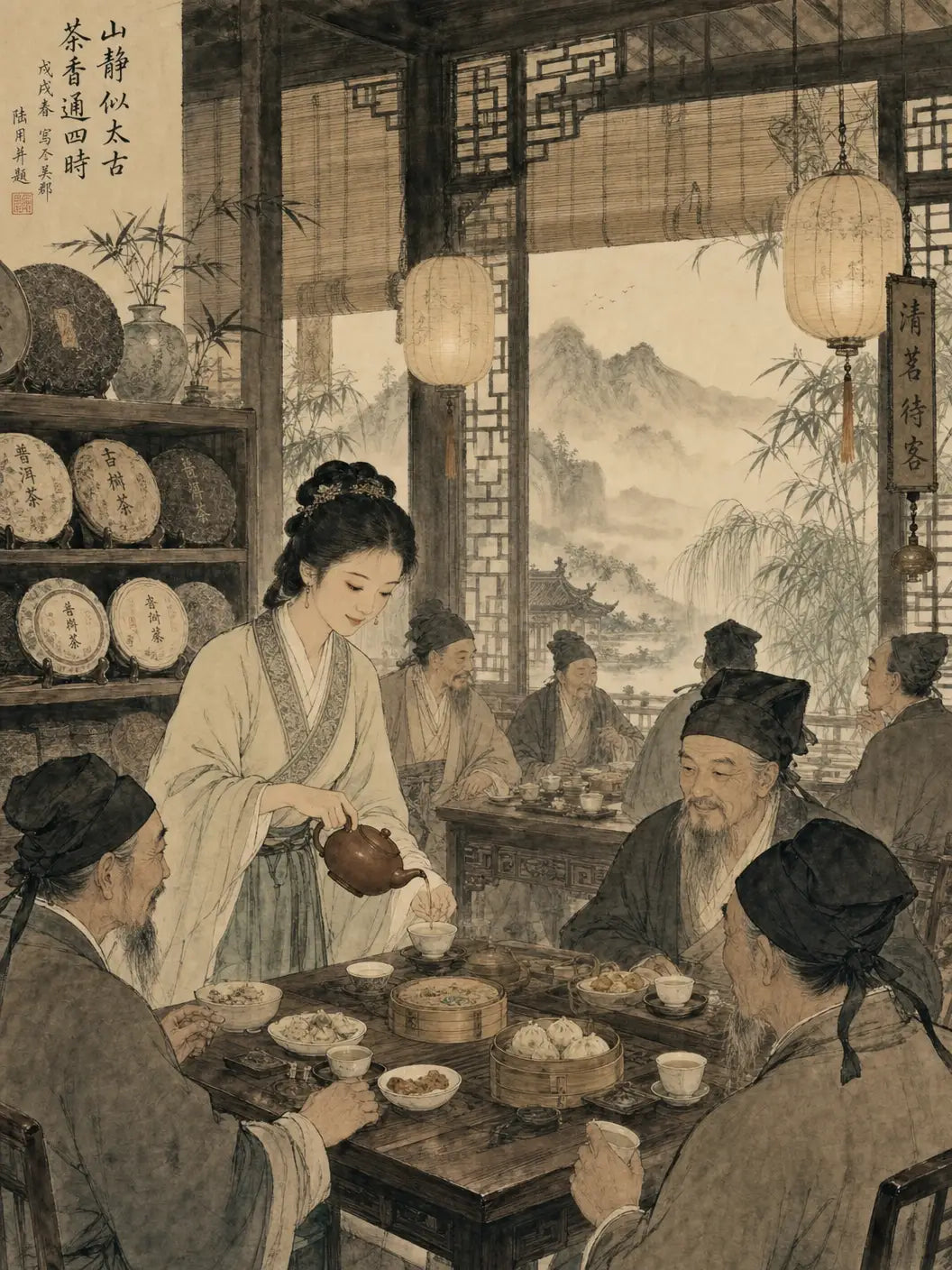
In southern China, particularly in Guangzhou (Canton) and Hong Kong, Pu'er is served during yum cha. Yum cha, literally "drinking tea," is the ritual of dim sum, those small bites shared with family or friends in the morning and at noon. Pu'er holds the central place as the meal's tea. This is neither an accident nor a local trend. It is the result of observation passed down from generation to generation.
Classical Chinese thought attributes to Pu'er, especially fermented Pu'er (shou), the ability to aid in the digestion of rich and hearty dishes. In Cantonese cuisine, which is rich in meats, sauces, and fried foods, Pu'er plays the role that a digestif plays elsewhere: it settles the meal, it soothes, it accompanies.
This tradition is ancient. Li Shizhen, a physician and naturalist of the Ming dynasty, already mentioned the digestive virtues of dark teas in his Compendium of Materia Medica, a work published in 1578. Subsequent Chinese classics only confirmed this practice, which was then transmitted through daily use throughout East Asia. Even today, in any Cantonese restaurant in Paris or Hong Kong, you will be offered Pu'er to accompany your meal even before you have opened the menu.
What Fermentation Transforms in the Leaf
Pu'er is not like other teas. Where green tea has its oxidation stopped by quick firing, and Western black tea is fully oxidized then stabilized, Pu'er follows a third path: post-fermentation. To better understand this distinction, we have detailed it in our article on the difference between raw and fermented Pu'er.
Two paths coexist. Sheng, or raw Pu'er, ferments slowly over time, under the action of air, humidity, and microorganisms naturally present on the leaf. Shou, or fermented Pu'er, undergoes a human-guided fermentation, shorter and more intense, called wo dui or "wet piling." Developed in 1973 at the Kunming Tea Factory and perfected in Menghai, this technique replicates in a few months what slow fermentation takes years to accomplish.
In both cases, what happens inside the leaf is a profound transformation. Catechins, abundant in fresh green tea, are partially converted into theaflavins, thearubigins, and theabrownins—compounds that give Pu'er its amber color and round character. Complex sugars are simplified. New compounds appear, shaped by the microorganisms in the fermentation pile or by the patient work of time.
This transformation is what makes Pu'er smoother on the palate, and it is also what functionally links it to fermented foods that Western cuisine is rediscovering today: kefir, kombucha, sauerkraut. Pu'er is, strictly speaking, a living tea. A leaf that continues to evolve in the cake or in loose form, years after harvest.

Polyphenols and Theabrownins: What Researchers Are Studying
For the past twenty years, several research teams have been interested in the active compounds of Pu'er.
Theabrownins, pigments specific to fermented Pu'er, are the subject of international publications on their antioxidant properties and their interaction with certain digestive enzymes. Research conducted notably in China and Japan has described, in the laboratory, an interaction between theabrownins and pancreatic lipase, the enzyme that breaks down dietary fats. Researchers observe that at the cellular level, this interaction modifies the kinetics of lipid absorption.
The convergence between traditional observation, rooted in several centuries of use, and the first laboratory measurements is notable enough to warrant attention.
Tea polyphenols, more broadly, are recognized by the European Food Safety Authority as contributing to the protection of cells from oxidative stress. This general effect, shared by all teas, takes a particular form in Pu'er due to fermentation. Where green tea offers fragile catechins, Pu'er provides a palette of more stable compounds, inherited from its transformation.
Sheng or Shou: Which for Digestion?
The question comes up often. If you're looking for a Pu'er to accompany your meals, should you choose a sheng (raw) or a shou (fermented)?
In Chinese tradition, it is shou that plays the digestive role. Milder, rounder, without marked bitterness, it invites itself after heavy dishes without competing with them. Its mahogany liquor, its silky texture, its notes of undergrowth and soft leather make it a tea that reassures rather than stimulates. It is the Pu'er that Cantonese families keep close at hand, from breakfast to dinner.
Sheng has a different energy. In its youth, it is lively, sometimes astringent, more invigorating. Chinese tradition tends to attribute it to moments of awakening during the day, or as an appetizer. With age (ten, twenty, thirty years), it softens and approaches shou in gentleness, while retaining a depth that shou does not develop. An aged sheng and a well-made shou cross paths in their register, without however being confused.
For beginners, or for those primarily seeking a meal companion, we always recommend a shou. It is the Pu'er for first-timers. Our organic fermented Gong Ting bud Pu'er is precisely designed for this use: an imperial grade, loose leaf, which withstands several infusions without losing flavor, and which is at home on an embroidered tablecloth as much as at a desk.
When and How to Drink a Digestive Pu'er
The Cantonese practice is clear: Pu'er is drunk during and after the meal. During, in small sips, to accompany the bites. After, in longer infusions, to conclude the meal. The action is simple, the ritual can be adapted, and it also changes according to the time and season.
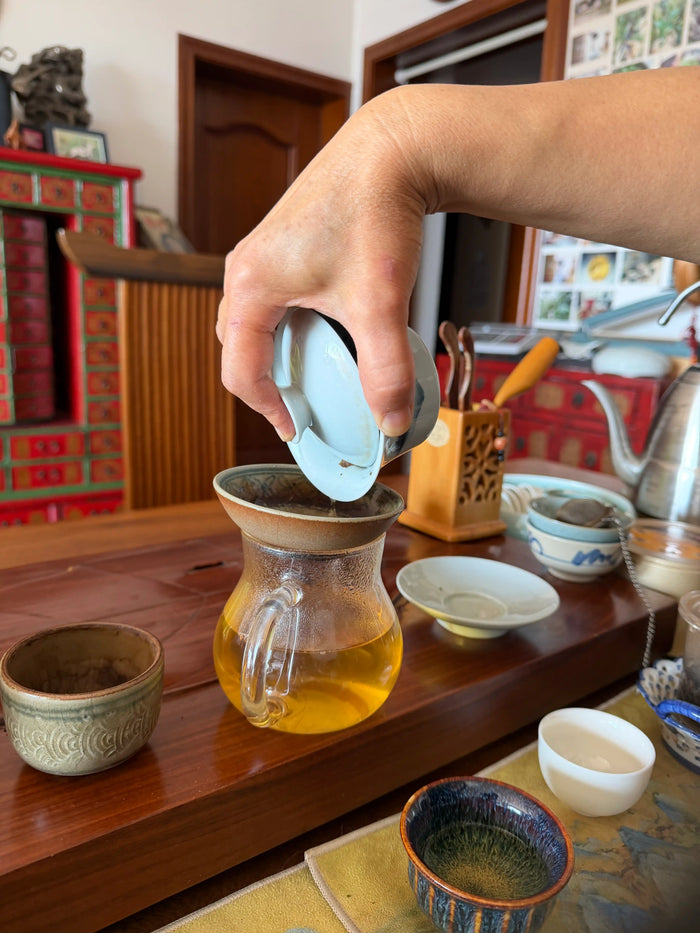
Preparation can remain very accessible. A classic teapot or a gaiwan is sufficient. Count four to five grams for twenty centiliters of water, simmering water around 95 degrees, a first five-second rinse that is discarded to awaken the leaf, then infusions of ten to twenty seconds that are gradually lengthened. A good Pu'er easily accepts six to eight infusions, sometimes more. If you wish to go further with the technique, our complete guide to preparing Pu'er details each method.
The theine in Pu'er is less stimulating than that of green tea. Fermentation transforms part of the caffeine, and the felt effect is more grounding than tense. A Pu'er in the evening does not disturb sleep for most drinkers, unlike a green tea taken at the same time. This is one of the discreet advantages of fermented Pu'er: it accompanies you without pulling you away from the rest that follows.
Pu'er also tolerates thermos preparation very well, what Chinese tradition sometimes calls "the driver's tea": a few grams left to infuse slowly in a thermos of hot water, to drink throughout the day. It's less precise, but it's effective, and it's what many Chinese enthusiasts do daily. A simple way to invite Pu'er into a workday, without ceremony.
What we can say is this. Chinese tradition has associated fermented Pu'er with accompanying rich meals for centuries, in cultures where it is consumed daily. Contemporary science is beginning to shed light on some of the possible mechanisms of this tradition. And we, Elouan and Qiao, have been drinking this Pu'er, which we hand-make in Yunnan, from harvest to cake, for over thirty years after meals. To go further into the Chinese interpretation of Pu'er, we have dedicated a full article to the benefits of Pu'er in traditional Chinese medicine.
This is what we call, in our culture, tradition: a patient, transmitted, still-living observation.
Our Selection of Pu'er for Meal Accompaniment
For those who want to experience Pu'er at the table, here are two entries from our catalog, from the most accessible to the most refined.

Our organic fermented Gong Ting bud Pu'er is the most complete meal companion. An accessible, imperial-grade loose leaf that withstands several infusions without losing its flavor. It's what we drink at home and what we first offer to those discovering Pu'er.
For connoisseurs who want to taste what patience brings to a fermented Pu'er, our XianLingZhi Bingdao 20-year-old offers a depth that only time can build: a fermentation conducted two decades ago, whose notes have rounded out year after year until reaching that very special smoothness of well-aged shou.
Frequently Asked Questions
Which Pu'er to choose for accompanying meals?
Fermented Pu'er (shou) is traditionally preferred for accompanying meals, especially for rich, fatty dishes. Gentler than sheng, without marked astringency, it settles the meal rather than awakening it. Our organic Gong Ting bud Pu'er is a good entry point into this category, both for the consistency of its liquor and its everyday accessibility.
How many cups of Pu'er per day, after meals?
In Cantonese tradition, Pu'er is drunk in several small cups throughout and after the meal. Two to four cups, over an hour or two, is a common rhythm. Pu'er in a gaiwan or classic teapot allows for six to eight infusions from a single serving, which simplifies daily use without wasting the leaves.
Does Pu'er contain a lot of theine?
Pu'er contains theine, but less than green tea or coffee at an equivalent dose. Fermentation transforms part of the caffeine, and the felt effect is more calming than stimulating. For most drinkers, fermented Pu'er taken at the end of a meal or in the evening does not disrupt sleep, making it a tea compatible with late consumption.
Does Pu'er help with weight loss?
No food alone can cause weight loss. Cantonese tradition associates fermented Pu'er with accompanying fatty meals, and some research teams are studying its interactions with enzymes that break down fats. The right approach remains a balanced diet and regular physical activity, of which Pu'er tea is a very useful companion.
How long should Pu'er be steeped for digestion?
Short, repeated infusions are more effective than a single, long infusion. Steep for ten to twenty seconds, gradually increasing the time. Simmering water around 95 degrees is perfect. For daily use without ritual, preparing it in a thermos with a few grams left to infuse slowly also works very well.
Tasting a fermented Pu'er after a meal is the simplest way to understand what the Cantonese have known for centuries. Start with our organic Gong Ting bud Pu'er; it's what we drink at home.
To learn more about the subject, read our article on the benefits of Pu'er in Chinese medicine.