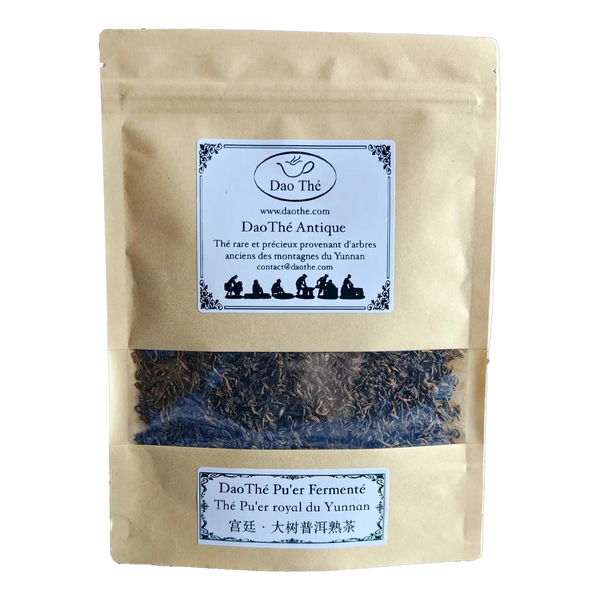
Bingdao Gushu Gong Ting FuTuo Pu'er
✦ Naturally low in caffeine, enjoyed from morning to night
€7 / piece (5 g nugget).
Handmade in Yunnan, from harvest to tea cake.
Naturally very low in caffeine. Gong Ting buds from thousand-year-old Bingdao trees, in nuggets.
This fermented Gong Ting Pu'er is one of the rarest teas we have ever offered. Its buds come from thousand-year-old tea trees, the trees of Bingdao, in the Mengku region. Harvested and shaped by hand, in our workshop in Yunnan.
A dark, deep liquor of remarkable roundness. Notes of precious wood, date, forest floor and soft leather. A natural sweetness that lingers long on the palate: the signature of great gushu.
Why this tea
Naturally very low in caffeine. The long fermentation of Shou Pu'er removes most of the caffeine. This tea can be drunk at any hour, including in the evening and after meals, without disturbing sleep. It suits adults and children alike, seasoned tea drinkers and newcomers alike.
Gong Ting, the imperial grade. In the hierarchy of fermented Pu'er, Gong Ting is the finest there is: only the youngest, most tender buds — those once reserved for the Imperial Court — go into it. The resulting liquor is silkier, sweeter, deeper than that of ordinary grades. We selected them by hand from the oldest trees of Bingdao.
A companion to meals and to the close of the day. In Chinese tradition, fermented Pu'er has been associated with digestion for centuries, enjoyed after meals, reputed in that tradition for its inner warmth and its support of the liver. Its round, gentle character has made it inseparable from the great tables of southern China.
Pu'er is a traditional beverage, to be enjoyed as part of a varied diet and a balanced lifestyle. It is not a substitute for medical advice.
Origin and terroir
Bingdao is one of the most coveted terroirs of Yunnan. Set in Mengku, in Lincang, this mountain village shelters tea trees of a hundred and of a thousand years. These are trees that have lived through dynasties, through centuries of mist and monsoon. Their roots reach so deep into the earth that no one irrigates them, no one fertilises them. They grow alone, as they always have.
In China, these old tea trees have a name: the gushu (古树). The older a tea tree, the fewer its leaves, and the more they concentrate a mineral and aromatic complexity that young plantations cannot reproduce. It is this raw material, among the rarest in the world, that makes up this Gong Ting.
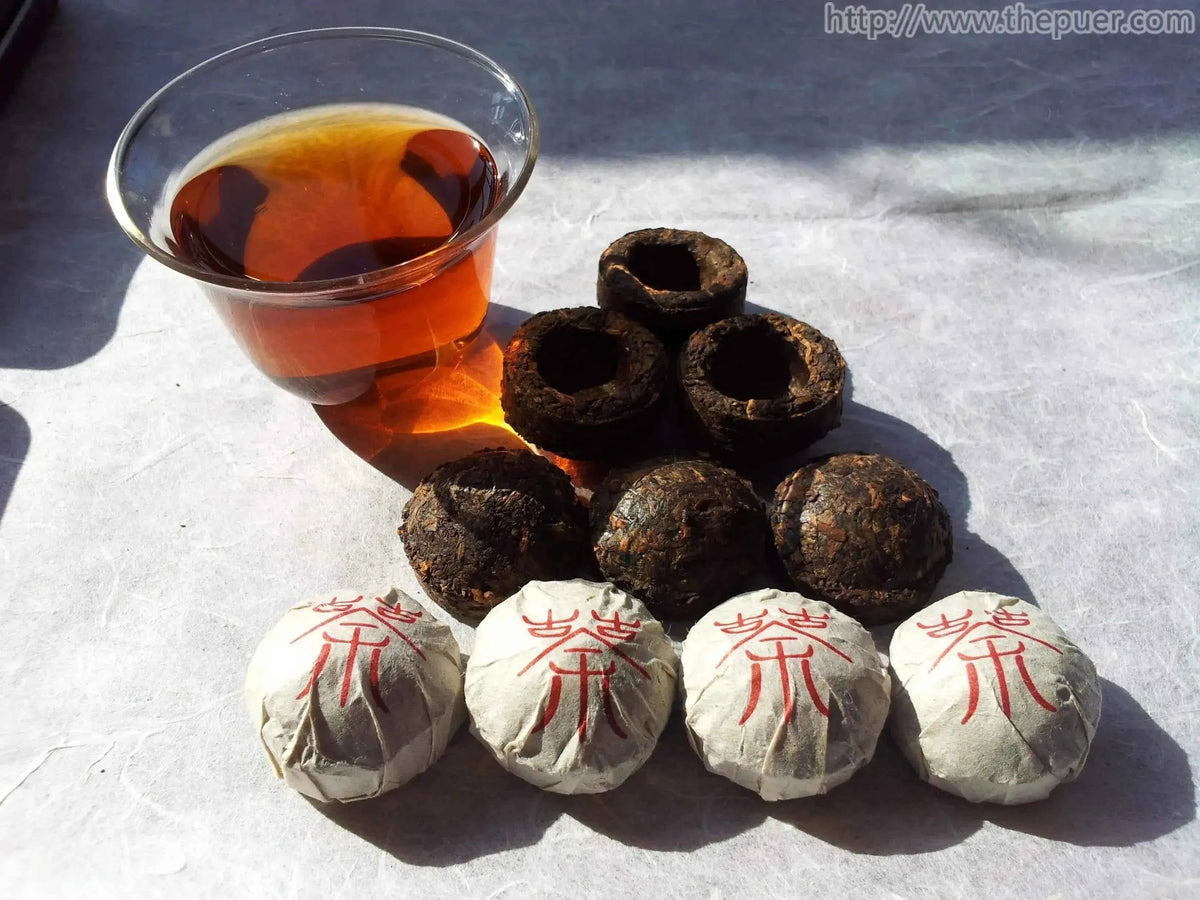
The buds were harvested by hand, selected among the finest, fermented by the traditional method of Shou Pu'er — a long, controlled fermentation that deeply transforms the leaf — then compressed into nuggets shaped like small domes. This ancient format, called FuTuo, preserves the aromas and makes dosing easy: each 7 g nugget is a ready-to-use measure.
Preparation
A 7 g nugget is one measure. Place it whole in your vessel (gaiwan, tea ball, teapot or thermos) without breaking it. It will loosen on its own on contact with hot water, releasing its aromas gradually, infusion after infusion. Use a low-mineral water, brought to a full boil: Shou Pu'er loves heat.
With a gaiwan, to reveal its full complexity. One nugget in a 100 to 150 ml gaiwan, water at a full boil. No rinsing with our teas — they are clean and pure. Then follow with short infusions, ten seconds for the first, lengthening gradually. Gong Ting gushu easily withstands twelve infusions or more, unveiling a new layer with each round. This is how it gives the best of itself.
With a tea ball, the everyday gesture. Place a whole nugget in your tea ball, set it in your cup or teapot, pour water at a full boil, let it steep three to five minutes. The damp nugget can give a second, even a third infusion by steeping a little longer. Simple, clean, without ceremony.
In a teapot, preferably Yixing clay. One nugget per litre of water at a full boil, three to five minutes for the first infusion. Re-infuse the leaves, lengthening the time gradually. A teapot devoted to this tea gathers, over the months, a little of its aromatic memory: this is the tradition of Yixing teapots, made to age with their tea.
In a thermos, the traveller's method. One nugget straight into the thermos, water at a full boil. Shou Pu'er, steeped at length, stays gentle and round, never turning astringent. Top up with water through the day: a single nugget is enough from morning to evening.
Storage
Fermented Pu'er improves with time. Keep your nuggets away from light, humidity and strong odours: coffee, spices, household products. An opaque tin, wooden or ceramic box is ideal. Avoid airtight plastic, which stifles the natural fermentation. The nuggets can be forgotten for months or years in a cupboard: they will wait for you, and they will have changed.
Tasting notes
The liquor is dark, deep, with a clarity that surprises for so dark a tea. The nose opens on notes of precious wood, date and fresh undergrowth. On the palate, the roundness is immediate, silky, enveloping, without the slightest astringency. Then come notes of soft leather, candied fruit, sometimes a light touch of camphor that betrays the age of the trees. The finish is long, gentle, marked by that huigan, the sweet return, that only great gushu know how to leave.
With the years, the notes move towards old wood, gentle spices, a depth that few teas in the world can offer. It is a living tea, in the truest sense of the word.
Characteristics
| Type | Fermented Pu'er (Shou Pu'er) |
| Grade | Gong Ting (imperial buds) |
| Terroir | Bingdao, Mengku, Yunnan, thousand-year-old trees (gushu) |
| Format | Compressed FuTuo nugget, 7 g, sold individually |
| Production | One-off, will not be renewed |
To go further
Three reads to know this tea better and prepare it as we do.
- What is Pu'er tea? — origins, terroirs, traditional virtues.
- Fermented Pu'er or raw Pu'er — two families, two characters, how to choose.
- How to prepare Pu'er tea — gaiwan, teapot, tea ball, thermos.
Detailed characteristics
| Terroir | Village of Bingdao, Mengku region, Yunnan |
| Altitude | 1,800 to 2,000 metres |
| Type | Shou (fermented) |
| Grade | Gong Ting Gushu (imperial, ancient tea trees) |
| Harvest | Recently pressed, ancient tea trees |
| Aromatic profile | Deep, woody, silky |
| Ageing potential | 15 years and more |
| Sourcing | Direct sourcing, ancient tea trees (gushu), Bingdao |
Who it's for
For enthusiasts who want to taste an imperial-grade shou from ancient trees, in a practical nugget format.
Ideal for everyday tasting or for travel.
Chinese tradition attributes to gushu shou a particular roundness, inherited from the patience of the trees.
To go further
Discover Gushu: what is an ancient-tree tea and Pu'er and probiotics on our blog.

Tea pressed by hand, as it was a thousand years ago
Qiao has been making tea for thirty years. By hand, following the old ways, she presses each cake herself on a stone mill, a craft handed down for more than a thousand years and today listed as intangible cultural heritage.
Our tea trees, some several centuries old, grow above 1,800 metres: we call them the "old immortals." Their leaves are fixed by hand in great woks heated over a wood fire, then rolled. Six months a year, we are there, at every step.