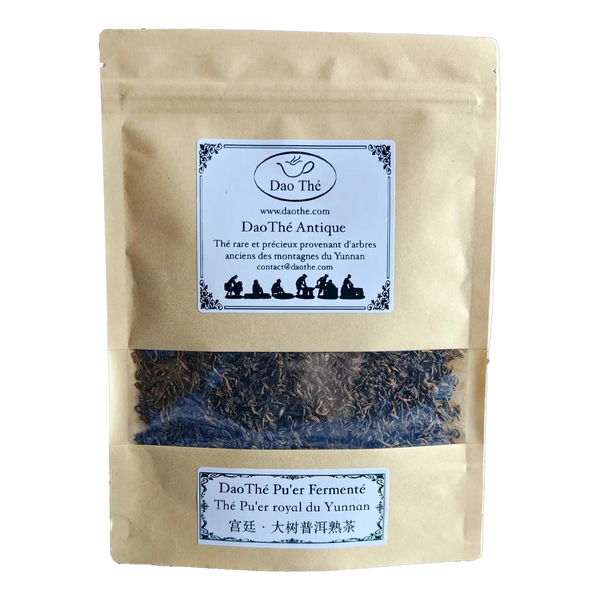
XianLingZhi Fermented Pu'er
✦ Naturally low in caffeine, enjoyed from morning to night
€75 / 50 g, i.e. €150 / 100 g.
Handmade in Yunnan, from harvest to tea cake.
Naturally caffeine-free. GongTing buds from thousand-year-old Bingdao trees, 20 years of slow fermentation.
This fermented Pu'er is our most accomplished tea. XianLingZhi — the mushroom of immortality in Chinese tradition — bears its name well: twenty years of maturing have transformed these golden buds into something rare, where power turns round and old wood turns to velvet.
A dark, deep liquor, almost black. Notes of old patinated wood, dried date and soft leather. An ample roundness from the very first sip, an energy that rises slowly and stays. A background of damp earth and cold incense, without bitterness.
Why this tea
Naturally caffeine-free. Twenty years of fermentation have completed what nature began: the caffeine has almost entirely dissipated. This Pu'er can be drunk at any hour, after dinner, late in the evening, without agitation or second thought.
The GongTing grade, the buds alone. In fermented Pu'er, GongTing (literally “imperial”) refers to the finest sorting: only the intact buds are kept, recognisable by their golden colour and velvety surface. For this XianLingZhi, the selection is done by hand, bud by bud, from the harvests of thousand-year-old Bingdao trees.
From Yunnan, handmade, from harvest to tea cake. Qiao — my wife and a tea master for thirty years — works the leaves of Bingdao, in Mengku, exactly as it was done before her. The trees from which these buds come have lived through centuries: their roots reach so deep that they have never needed human intervention to feed themselves. We harvest ourselves, we sort ourselves.
Virtues in Chinese medicine. In traditional Chinese medicine, a fermented Pu'er of this age is associated with a deep inner warmth and support for digestion. Tradition attributes to teas from ancient trees a more grounded, more lasting energy, which the classics traditionally associate with the spleen and stomach.
Pu'er is a traditional beverage, to be enjoyed as part of a varied diet and a balanced lifestyle. It is not a substitute for medical advice.
Origin and terroir, Bingdao
Bingdao lies in the mountains of Mengku, at the heart of Lincang, in Yunnan. The village shelters tea trees of a rare longevity, some exceeding a thousand years. These are gushu (古树): trees that have lived through dynasties, through centuries of mist and monsoon. Their roots reach so deep that no one irrigates them, no one fertilises them. They grow alone, as they always have.
This XianLingZhi was harvested twenty years ago, then fermented and kept in conditions that allowed it to mature without haste. The tannins have melted away, the wood has gained its patina, the roundness has taken all the room. It is a tea that has had the time to become what it was meant to be.
Preparation
A tea of this density asks for little leaf. Boiling water, 95 to 100 °C: Shou Pu'er loves heat. A low-mineral or spring water brings out the finesse of the GongTing grade.
With a gaiwan, to explore each infusion. Five grams in a 100 to 150 ml gaiwan. Boiling water, no rinsing: our teas are clean and pure. First infusion ten seconds, lengthening gradually. This tea holds fifteen to twenty rounds, unveiling a new layer each time. This is how it gives the best of itself.
With a tea ball, for the day. Three grams in a ball, one litre of boiling water, three to four minutes. The ball can serve again two or three times by lengthening the time. Simple, clean, without ceremony, and 50 g last a long while at this dose.
In a teapot, preferably Yixing clay. Four to five grams per litre, three to five minutes to begin. The porosity of Yixing absorbs the woody aromas over the infusions: a teapot devoted to this tea gains, over the months, a little of its aromatic memory.
In a thermos, for the office. Three grams at the bottom of the thermos, boiling water. The sweetness of this aged GongTing withstands a long infusion without bitterness: the liquor stays stable from morning to late afternoon.
Storage and ageing
This Pu'er already has twenty years of ageing and continues to improve. The woody aromas refine, the roundness deepens, the liquor fills out. Keep it away from light, humidity and strong odours: coffee, spices, household products. A ceramic, wooden or tin box, odourless, does the job perfectly. No airtight plastic box. Time works for you.
Detailed tasting notes
The liquor is dark, deep, almost black, with a clarity that surprises. On the nose, old patinated wood, dried date, a touch of cold incense. On the palate, the roundness is immediate, ample, enveloping, without the slightest astringency. Then come notes of soft leather and forest earth. The finish is long, marked by a gentle warmth and a sweet return that holds. No bitterness, no harshness: nothing but depth and time.
Characteristics
| Type | Fermented Pu'er (Shou Pu'er) |
| Grade | GongTing, imperial buds |
| Terroir | Bingdao, Mengku, Yunnan, thousand-year-old trees (gushu) |
| Age | 20 years of fermentation |
| Form | Whole leaves and buds, loose leaf |
| Net weight | 50 g |
To go further
Three reads to know this tea better and prepare it as we do.
- What is Pu'er tea? — origins, terroirs, traditional virtues.
- Fermented Pu'er or raw Pu'er — two families, two characters, how to choose.
- How to prepare Pu'er tea — gaiwan, teapot, tea ball, thermos.
Detailed characteristics
| Terroir | Village of Bingdao, Mengku region, Yunnan |
| Altitude | 1,800 to 2,000 metres |
| Type | Shou (fermented, aged) |
| Grade | Gong Ting (imperial) |
| Year | 2006 (20 years of ageing) |
| Aromatic profile | Leather, undergrowth, deep |
| Ageing potential | Excellent, already mature (continues to improve) |
| Sourcing | Direct from the Bingdao grower, 20-year traceability |
Who it's for
For advanced enthusiasts and collectors who want to taste a well-aged shou.
Drunk after meals or in the evening, gong fu cha style to reveal the complexity of the long maturing.
Chinese tradition prizes these old shou like bottles patiently kept in a cellar.
To go further
Discover Ageing your Pu'er and Pu'er and probiotics on our blog.

Tea pressed by hand, as it was a thousand years ago
Qiao has been making tea for thirty years. By hand, following the old ways, she presses each cake herself on a stone mill, a craft handed down for more than a thousand years and today listed as intangible cultural heritage.
Our tea trees, some several centuries old, grow above 1,800 metres: we call them the "old immortals." Their leaves are fixed by hand in great woks heated over a wood fire, then rolled. Six months a year, we are there, at every step.