Before being a beverage of pleasure, tea was a remedy. For centuries, China viewed it through this lens, and Pu'er, which grows in the mountains of Yunnan, holds a special place in this long tradition. Here's what traditional Chinese medicine says about it.

Three Thousand Years of Tradition
Tea entered the Chinese pharmacopoeia over two thousand years ago, during the Han dynasty. Before being drunk for pleasure, it was harvested, dried, and steeped as a medicinal plant among others, much like ginger root or chrysanthemum flower. The great classic Shennong Bencao Jing, attributed to the legendary Emperor Shennong, already mentions tea among the plants useful for body balance.
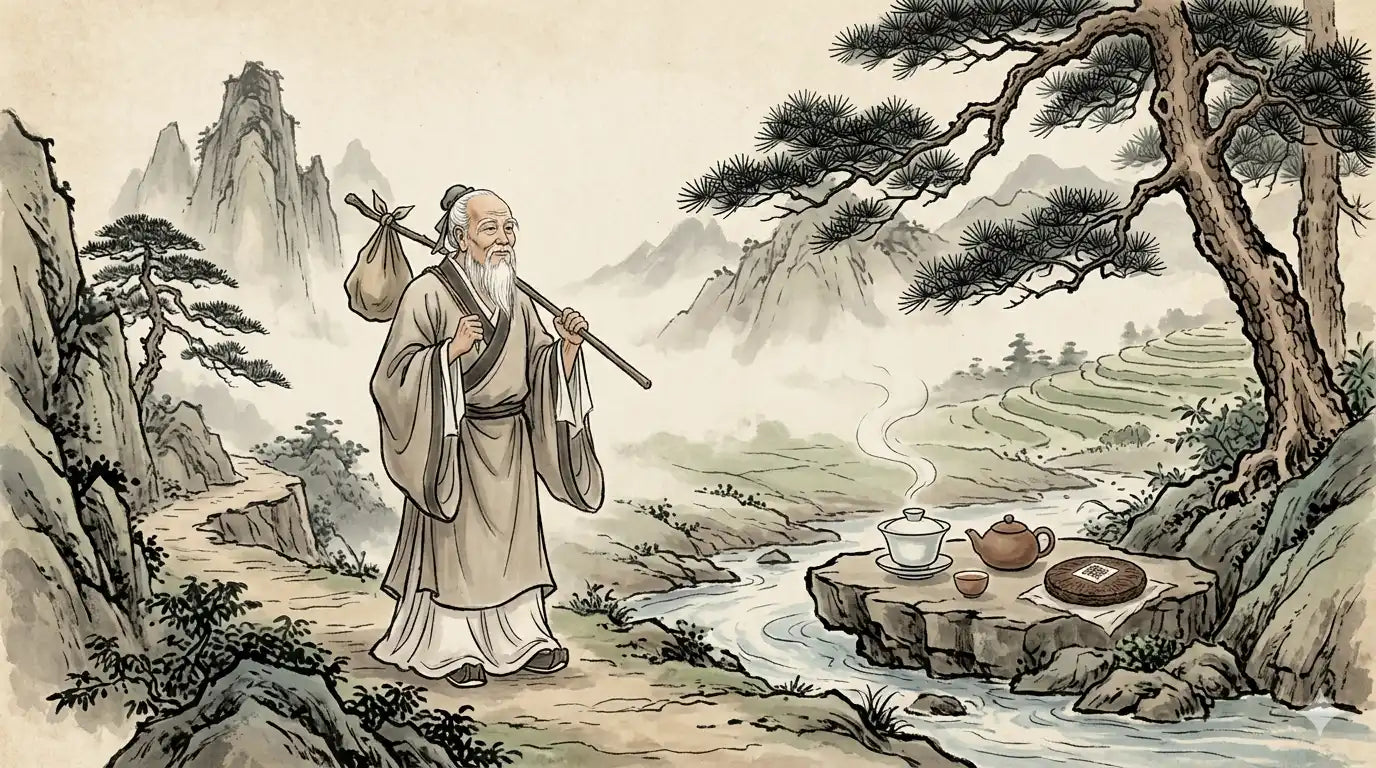
In the 8th century, Lu Yu wrote the Cha Jing, the Classic of Tea, which for centuries established the art of preparing and drinking tea. In it, Lu Yu already mentions the great tea trees of Yunnan whose compressed leaves traveled in caravans along the Tea and Horse Road to Tibet and Mongolia. At that time, Yunnan tea was less a ceremonial drink than a robust, generous, and useful daily companion.
Why Pu'er Holds a Special Place
In Chinese thought, every food has a hot, cool, or neutral nature and a path in the body. Classics traditionally associate Pu'er with the spleen and stomach, two organs that Chinese medicine considers central to what it calls internal balance.
The long fermentation of Pu'er, whether natural, as in aged sheng, or accelerated, as in shou, transforms the fresh leaf into something softer and rounder. Chinese tradition attributes a particular affinity to this fermented leaf for digestion, and it is this quality, even more than taste, that has made Pu'er famous in the Chinese pharmacopoeia.

Fermented Pu'er and Raw Pu'er: Two Natures
Chinese medicine distinguishes teas by their temperament. Fermented Pu'er (shou) is traditionally described as warm in nature: its long fermentation, in Chinese thought, gives it a quality that warms and soothes. It is the tea readily offered in winter, after rich meals, or to accompany moments when the body seeks warmth.
Raw Pu'er (sheng), especially when young, is considered cool. Tradition associates it with spring, brisk mornings, and energetic constitutions. With age, its coolness softens, and an old sheng can gradually take on the warmer nature of a fermented tea.
This idea that tea has a season, a time, a use is one of the most beautiful insights of Chinese thought. Drinking tea is not just about satisfying thirst: it is also about aligning what you drink with the moment, the mood, the time of day, and the season.
Enjoyed After Meals
If there is one traditional use of Pu'er that spans regions and eras, it is this: it is drunk at the end of meals. In southern China, in all provinces where Pu'er holds a place, the dark cup of tea naturally follows meat dishes, rich tables, and lingering meals.
Chinese tradition has long credited Pu'er, after meals, with supporting digestion. The caravanners of the Tea and Horse Road drank it for this reason, complementing their diet often rich in dried meat and dairy products. This habit has been passed down and, even today, is one of the most common daily tea rituals in China.

The All-Day Tea
Another unique characteristic of Pu'er, especially fermented, is its very low theine content. The long fermentation the leaf undergoes naturally degrades a large part of the theine it originally contained. Practically speaking, you can drink fermented Pu'er from morning until night without fearing any impact on sleep. This is a fact, not a promise.
It is for this reason, as much as for its taste, that Pu'er has become the everyday tea in Chinese families. In the mountains of Yunnan where we work six months a year, it is the tea steeped in a thermos at dawn and continued to be drunk until bedtime. A single dosage, water added throughout the hours, and the cup accompanies the day.
Frequently Asked Questions
Is Pu'er tea good for your health?
Traditional Chinese medicine has associated Pu'er with spleen and stomach balance for centuries, and it is traditionally enjoyed after rich meals for its gentleness and internal warmth. We refer to this as a traditional use, not a health promise: for any medical questions, please consult your doctor. It is also a very low-theine tea that can be drunk from morning to evening as part of a balanced diet.
Does Pu'er aid digestion?
This is the oldest and most widespread use in classical Chinese texts. Tradition credits fermented Pu'er, after meals, with digestive support qualities. The caravanners of the Tea and Horse Road drank it after meats and fatty foods—a practice that continues today in all families in southern China.
What is the difference between fermented Pu'er and raw Pu'er in Chinese medicine?
Chinese medicine distinguishes them by their thermal nature. Fermented Pu'er (shou) is considered warm: it warms, soothes, and is suitable for cold evenings and rich meals. Young raw Pu'er (sheng) is considered cool: livelier and more invigorating, it is better suited for mornings and warm seasons. An aged sheng softens its nature over the years and gradually approaches that of a fermented tea.
Can fermented Pu'er be drunk every day?
Yes, it is even the most common practice in Chinese families in producing regions. Its very low theine content, due to long fermentation, allows it to be drunk from morning to evening without disturbing sleep. In the mountains of Yunnan where we work, it is steeped in a thermos at dawn, and the same leaves provide color until bedtime.
Does Pu'er contain caffeine?
Like all tea from Camellia sinensis, Pu'er naturally contains caffeine. However, the long fermentation of shou degrades a large part of it. Practically speaking, fermented Pu'er is one of the least caffeinated teas on the market, well below a green tea or a classic black tea. This is why it can be drunk in the evening without issue, and why Chinese families also give it to younger people.